
Best Valve Manufacturers for EPC Oil and Gas Pipeline Projects in the Middle East | Approved Vendor List Strategy
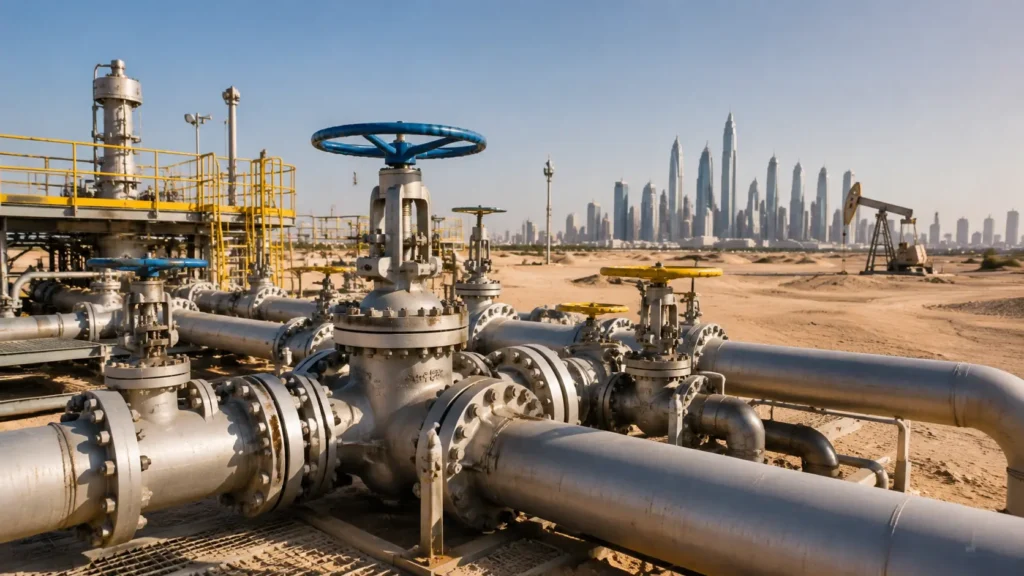
Quick answer: For large API 6D pipeline isolation valves, EPC contractors commonly evaluate SLB Cameron, Flowserve Valbart, PetrolValves and Neway. Emerson Fisher and Baker Hughes Masoneilan are stronger choices for control valves, while Baker Hughes Consolidated specializes in pressure relief valves. Velan and Valvitalia can suit mixed station packages. No manufacturer is approved for every Middle East project. Check the operator, factory, valve type, material range and approval status before placing an order. A well-known brand is not enough. The offered valve must match the fluid, pressure, temperature, valve function and project specification. The exact manufacturing plant must also be approved. Important: This article supports vendor screening and procurement planning. Final valve selection must follow the project datasheet, valve specification, piping class, safety study and owner approval. Key Data at a Glance Item Useful reference What it means Common ASME pressure classes Class 150, 300, 600, 900, 1500 and 2500 The class number is a rating category, not the valve pressure in psi. Actual pressure depends on material and temperature. LNG temperature About −162°C or −260°F An LNG valve needs suitable low-temperature materials, seals, bonnet design and cryogenic testing. API 6D quality levels QSL 2, QSL 3/3G and QSL 4/4G Higher levels add stricter material, inspection, testing and document controls. “G” levels include high-pressure gas testing. Comparable reference example NPS 12 Class 300 is not equal to NPS 36 Class 900 The larger, higher-class valve has different body loads, seat forces, torque, machining and testing risks. Example supplier references At least 3 similar operating references This is a practical project target, not an API or ASME rule. ASME valve and flange systems commonly use Classes 150, 300, 600, 900, 1500 and 2500.[1] A Class 600 valve is not simply a valve rated to 600 psi. Its permitted pressure changes with the body material and design temperature. LNG is natural gas cooled to about −162°C, or −260°F. In liquid form, it occupies about 1/600 of the volume of natural gas in its gaseous state.[2] Best Manufacturers by Use Project need Manufacturers commonly evaluated Why they are shortlisted Main point to check Large pipeline ball valves SLB Cameron, Flowserve Valbart, PetrolValves, Neway Large-bore trunnion and pipeline designs Factory approval, similar references, seat design and gas testing Fully welded ball valves SLB Cameron, Flowserve Valbart, Neway Fewer bolted body joints for buried pipelines Repair method, cavity relief, weld ends and local support Top-entry ball valves PetrolValves, Flowserve Valbart, Velan ABV Internal parts may be reached without removing the valve body Lifting space, special tools and spare parts Pipeline gate valves SLB Cameron, Flowserve, PetrolValves, Neway Full-opening flow path and pigging options Slab or expanding design, seat wear and cavity pressure Pipeline check valves SLB Cameron, Flowserve, Neway, Velan Swing, dual-plate and axial-flow designs Minimum stable flow, closing response and surge risk Control valves Emerson Fisher, Baker Hughes Masoneilan Sizing, noise control and severe-service trims Cv, valve opening, cavitation, noise and actuator thrust Pressure relief valves Baker Hughes Consolidated Specialized overpressure protection Relieving case, certified capacity and backpressure Gas regulators Baker Hughes Becker and Mooney Natural-gas pressure control Flow range, pilot design and fail action Mixed station packages Flowserve, Velan, Neway, Valvitalia Several valve types from one supplier group Factory allocation, package responsibility and documentation This table is an initial shortlist. It does not prove approval by Saudi Aramco, ADNOC, QatarEnergy, Kuwait Oil Company or another operator. SLB Cameron Best for: Large-bore pipeline ball valves, fully welded ball valves, through-conduit gate valves and check valves. Cameron is commonly considered for mainline pipeline isolation. Its product families include fully welded and bolted-body ball valves, slab and expanding gate valves, check valves and double-block-and-bleed designs. A fully welded body removes the large bolted joints between body sections. This reduces one group of possible external leak paths, which can be useful for buried and remote pipelines. It does not remove leakage risks at the stem, seats, vents, drains or injection fittings. Check before approval: Confirm the exact factory, body construction, seat arrangement, fire-test range, actuator package and local repair support. For buried valves, review the stem extension, vent and drain lines, coating limits and valve-pit arrangement. A top-entry or bolted design may be easier to repair when internal access is important. See this side-entry vs top-entry ball valve comparison. Flowserve Best for: Combined pipeline, terminal, LNG, refinery and process-valve packages. Flowserve supplies valves through brands such as Valbart, Serck Audco, Nordstrom, Argus, McCANNA, Valtek and MOGAS. It also supplies Limitorque actuation products. Its main advantage is product coverage. One project may source pipeline ball valves, plug valves, control valves, severe-service valves and actuators through the same supplier group. Check before approval: Do not treat every Flowserve brand or plant as one approved source. Require a tag-by-tag list showing the design owner, manufacturing plant, actuator assembly plant, final test location and warranty holder. For lubricated plug valves, check the injection schedule and fluid compatibility. For combined packages, one company should accept responsibility for the complete valve and actuator assembly. Emerson Best for: Control valves, high pressure drop, cavitation, noise control, actuators and valve diagnostics. Relevant products include Fisher control valves and regulators, KTM ball valves, Keystone butterfly valves, Vanessa triple-offset valves, Bettis actuators and FIELDVUE positioners. A control valve cannot be selected from pipe size alone. The supplier needs the minimum, normal and maximum flow, inlet and outlet pressure, temperature, fluid data, shutoff class, noise limit, air pressure and fail position. Check before approval: Review Cv, valve opening, outlet velocity, noise, cavitation or flashing risk, actuator thrust and stem stress for every operating case. A valve sized only for maximum flow may run almost closed during normal operation. This can cause poor control, noise and faster trim wear. A control valve should not also serve as the only emergency isolation barrier unless the project safety study allows it. Baker Hughes Best for: Control valves, pressure relief valves, gas regulators and pressure-control stations. Its main product families include Masoneilan control valves, Consolidated pressure relief valves, Becker natural-gas control
Full Bore vs Reduced Bore Ball Valve | Pressure Drop, Pigging Capability, and Cost Analysis
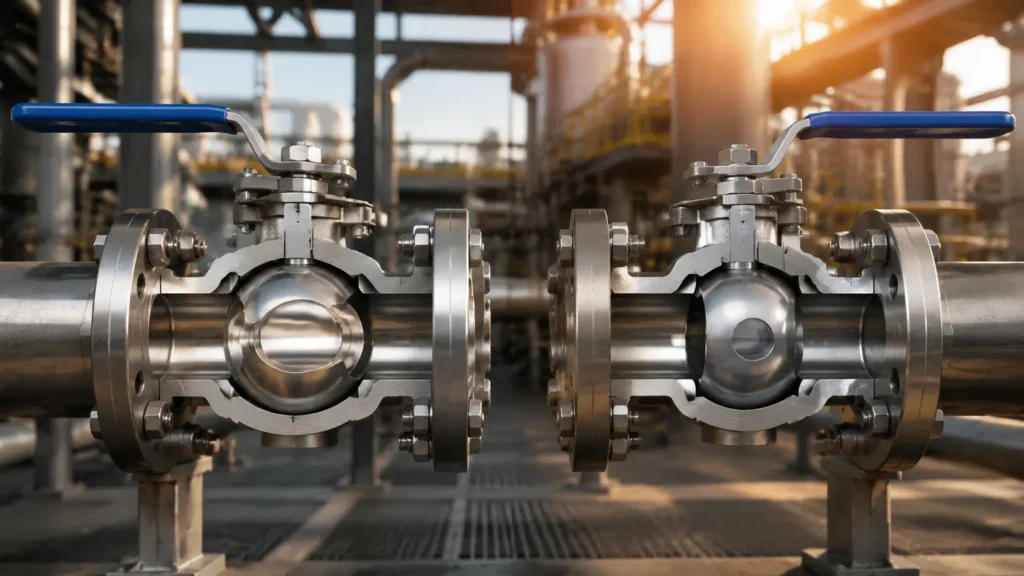
Full bore ball valves are usually better for piggable pipelines, high continuous flow, pump suction lines, and fluids containing solids or deposits. Reduced bore valves can reduce purchase cost and weight, but they create a smaller flow area, higher local velocity, and greater pressure loss. A reduced bore valve is suitable when the line is clean, flow is low or intermittent, pigging is not required, and the calculated pressure loss remains within the system limit. The final choice should be based on the actual bore, Cv or Kv, pipe dimensions, flow rate, fluid properties, torque, and total lifecycle cost. Quick Comparison Item Full Bore Reduced Bore Internal opening Close to the required pipe bore Smaller than the pipe bore Flow capacity Higher Lower Pressure drop Lower Higher Local velocity Lower Higher Conventional pigging Usually suitable after passage checks Usually unsuitable unless specially engineered Solids and deposits Better passage Higher blockage and wear risk Valve weight Usually higher Usually lower Operating torque Often higher Often lower Initial cost Usually higher Usually lower Energy cost Usually lower Can be higher These are general differences. Two valves with the same nominal size can have different bore dimensions, flow coefficients, seat designs, body lengths, weights, and torque values. Bore Size NPS and DN are nominal connection sizes. They do not show the exact inside diameter of a pipe or valve. Pipe inside diameter changes with wall thickness and schedule, so an NPS 8 pipe does not always have an 8-inch inside diameter.[1] The minimum valve passage may be limited by: The opening through the ball The seat-ring opening The valve body passage The flange or weld-end bore Internal coating or lining Weld metal projecting into the pipe Misalignment between the ball, body, and connecting pipe The smallest opening controls pig clearance. The complete internal shape affects pressure loss. The terms full bore, full port, and full opening are often used for the same basic design. Reduced bore, reduced port, and standard port usually describe a smaller opening. Because manufacturers may use these terms differently, check the minimum bore shown on the certified drawing. Bore type is not the same as pressure class. A reduced bore valve can have the same pressure class as a full bore valve. Pressure class tells you the valve’s pressure-temperature rating. Bore type tells you the size of the flow passage. For more detail, see this guide to full bore ball valves and pigging requirements. Flow Area Flow area depends on the square of the bore diameter: A = πD² / 4 This means a small decrease in diameter produces a much larger decrease in flow area. Bore Diameter Reduction Remaining Flow Area Flow Area Lost 10% 81.0% 19.0% 15% 72.3% 27.8% 20% 64.0% 36.0% 25% 56.3% 43.8% 30% 49.0% 51.0% For example, reducing an opening from 8 inches to 6 inches reduces the diameter by 25%, but it removes about 44% of the flow area. Opening Flow Area Area Compared with 8 Inches 8 inches 50.3 in² 100% 6 inches 28.3 in² 56.3% The area ratio does not directly equal the pressure-loss ratio. Pressure drop also depends on the seat opening, passage length, inlet shape, downstream expansion, internal surface, and pressure recovery. Use the exact valve Cv or Kv for pressure-drop calculations. Flow Velocity When the same flow passes through a smaller area, local velocity increases: V = Q / A The table below shows how bore reduction affects velocity when the flow rate stays the same. Bore Diameter Reduction Remaining Flow Area Local Velocity Increase 10% 81.0% 23% 15% 72.3% 38% 20% 64.0% 56% 25% 56.3% 78% 30% 49.0% 104% A 30% reduction in bore diameter leaves only 49% of the original flow area. Local velocity therefore becomes slightly more than twice the original value. Assume a water flow of 3,000 US gallons per minute, or about 6.68 ft³/s. Opening Area Local Velocity 8 inches 0.349 ft² 19.1 ft/s 6 inches 0.196 ft² 34.0 ft/s The 6-inch opening raises local velocity by about 78%. These values are calculation examples, not recommended operating limits. Acceptable velocity depends on the fluid, pipe material, vapor pressure, solids content, noise limit, and erosion risk. The higher velocity exists inside the smaller valve passage. The velocity in the larger upstream and downstream pipe remains based on the pipe’s own inside diameter. Higher local velocity can increase: Erosion from sand, scale, rust, or catalyst particles Noise and vibration Seat and coating wear Downstream turbulence Cavitation risk in liquid service Pressure Drop Cv and Kv are the main values used to compare the flow capacity of actual valve models. Cv is commonly used with US customary units. For a water-like liquid under suitable conditions: ΔP = SG × (Q / Cv)² ΔP = pressure drop in psi SG = liquid specific gravity relative to water Q = flow in US gallons per minute Cv = valve flow coefficient Kv is the metric flow coefficient. K is a dimensionless resistance value often used in complete pipe-network calculations. Valve sizing standards use different equations and correction factors for liquids, gases, viscosity, attached fittings, choking, and pressure recovery.[2] Use the Cv or Kv for the exact valve size, pressure class, bore, seat design, end connection, flow direction, and opening position. The table below shows how a lower Cv affects pressure drop when flow and liquid specific gravity stay unchanged. Valve Cv Compared with the Reference Valve Pressure-Drop Multiplier 90% 1.23× 80% 1.56× 70% 2.04× 60% 2.78× 50% 4.00× 40% 6.25× 25% 16.00× If one valve has half the Cv of another valve, it creates four times the pressure drop at the same liquid flow. If its Cv is one-quarter of the reference value, it creates 16 times the pressure drop. This mathematical relationship does not mean every reduced bore valve has the same Cv reduction. Use certified data for the offered model. For more examples, see this guide to ball valve pressure-drop calculations. Pressure-Drop Example Assume a manufacturer offers two NPS 8 valves with the following full-open
Metal Seated Ball Valve Price Guide | Tungsten Carbide vs Stellite vs Ni-Based Coating Cost Breakdown
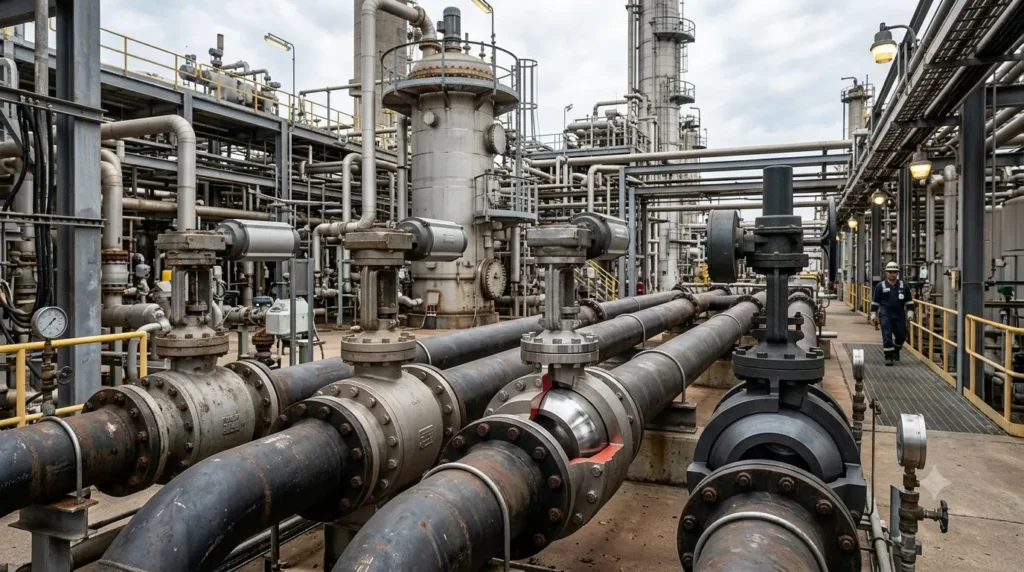
Service life differences across metal-seated ball valves come down to the hard-facing process used on the ball and seat sealing surfaces. HVOF tungsten carbide is usually a thin thermal-spray coating in the 100-300 μm range, while Stellite weld overlay and Ni60 spray-fuse layers are much thicker before final machining and lapping. Drawing on 12 projects our team has tracked over the past 18 months, initial prices for tungsten carbide HVOF spray, Stellite cobalt-based weld overlay, and nickel-based Ni60 self-fluxing alloy run 2x to 4x apart, yet total-cost-of-ownership rankings can flip once service life and maintenance frequency are factored in[1]. The lowest initial hard-facing price is not always the lowest total cost once maintenance interval, shutdown risk, and rework are included. This price comparison is most useful when the buyer already knows the medium, temperature, solids content, valve size, pressure class, leakage requirement, and expected maintenance window. If you are selecting a hard-facing process for sandy black-water lines, superheated steam, or Cl⁻ containing water injection valves, this price comparison will help you size the hard-facing cost per valve and match the coating choice with the service condition[2]. Hard-Facing Option Typical Price Position Main Strength Main Limitation Best-Fit Service Tungsten Carbide HVOF / WC-CoCr Highest Highest hardness and strong erosion resistance Higher cost and sensitivity to sustained high-temperature degradation Sand, black-water, ash-water, coal-slurry, and other particle-laden services Stellite 6 Weld Overlay Middle Hot-hardness retention, toughness, galling resistance, and thermal stability Lower hardness than tungsten carbide and sensitive to dilution/cooling control Superheated steam, hot oil, hydrocracker feed, FCC hot slurry, and thermal-cycling service Ni60 NiCrBSi Spray-Fuse Lowest Low cost, simple process, and useful corrosion resistance in suitable media Not suitable for severe erosion, strong oxidizing chloride media, or long-term high-temperature duty Low-to-medium temperature brine, H₂S/CO₂ reinjection water, weak acid/alkali, and small-bore valves Tungsten Carbide (HVOF Spray) HVOF Spray Price Tungsten carbide HVOF is the highest unit-area price among the three hard-facing options for metal-seated ball valves. A single sealing face package on a 4-inch valve, covering the ball plus two seats and about 0.01 m² of hard-faced sealing area, typically prices in at USD 280-420, with coating thickness 200-300 μm[3]. This 0.01 m² figure refers to the hard-faced sealing zones rather than the full outer surface area of the ball. In a 2024 quote package for a sandy black-water service, the WC-CoCr HVOF price came in 2.1x the Stellite 6 weld overlay and 3.0x the Ni60 spray-fuse process. WC-CoCr powder accounts for 38-45% of the total cost. The remaining cost is split across HVOF gun depreciation, process gas consumption, powder carrier gas, process setup, masking, booth operation, and matching-lapping labor. Typical gun life in our tracked quote packages is 250-300 hours. Booth and utility cost usually runs 8-12% of line operating expense. Surface preparation before spraying and final lapping after spraying are both important cost items. For high-grade metal-to-metal sealing, the final lapped sealing surface may need to reach Ra 0.05 μm, which adds another USD 60-90 per piece in many small and medium valve quotations. Spray distance: 200-300 mm. Combustion/flame temperature range used in quote assumptions: 2800-3200°C. Powder size: 15-45 μm. Spray booth environment: 20-25°C with 40-60% humidity. This mirrors the lapping shop environment rules under the China vs Italy vs India ball valve manufacturer price comparison document, which covers manufacturing depth at different regional suppliers[3]. HVOF spray direction tolerance is typically held to ±5° or tighter. Bore areas of 50-200 mm diameter and ball groove cavities usually require 3-5 spray passes at varying angles, which is a process-design cost often under-estimated in early inquiries. When the quote sheet only lists a per-piece hard-facing price without specifying spray-pass count, the actual delivered thickness uniformity usually shows 8-15% variation. In our experience on the 12 projects tracked in the past 18 months, customer-site rework averages another USD 80-160 per valve. The line item most often missed is process gas and carrier gas consumption, especially when multiple spray passes are needed for groove cavities and small bore areas. Third-party laboratory data in one tested sample showed HVOF WC-CoCr porosity around 2.3% by image analysis. Better-controlled HVOF and HVAF coating systems can reach much lower porosity, and HVAF variants can reduce oxidation and carbide degradation because of the different combustion and particle-heating conditions[4]. This is why the HVAF premium can be 15-25% even at the same powder grade. HVOF Cost Item Why It Matters WC-CoCr powder Usually the largest material cost item, accounting for 38-45% of the total. Spray pass count Affects coating thickness uniformity, curved-surface coverage, and rework risk. Process gas and utility cost Often missed in early quote comparisons. Final lapping Directly affects leakage performance and metal-to-metal sealing repeatability. Porosity and thickness inspection Shows whether the delivered coating matches the specification. Service Life With correct grade selection and matched lapping, HVOF tungsten carbide coatings deliver 2-4 years in particle-laden service. This range should be read together with the actual media velocity, solids content, particle size, temperature, pressure drop, valve cycling frequency, and leakage requirement. Our team tracked an HVOF metal-seated ball valve on a sandy water circulation line at a Fujian LNG receiving terminal in 2025; the first sample showing sealing-face pitting larger than 0.5 mm diameter appeared at 28 months of continuous run time[4]. The literature reference data show that HVAF-sprayed WC-CoCr can achieve very low porosity and high coating quality when powder size, spray parameters, and substrate conditions are controlled properly[4]. In our team’s 6-seat wear test running 18 months with 5% sand grit, 0.2-0.5 mm particle size, 5 m/s media velocity, and 60°C, the test data line up with this general trend. For high-temperature service selection, the API 6D ball valve Chinese manufacturer quality comparison lists a maximum service temperature of -29°C to 350°C, with short peak temperature up to 400°C, which can be used as a quick filter when temperature data is missing. HVOF failure usually starts with pitting, then develops into coating spalling if the sealing face keeps running in particle-laden service. Once a pitting pit exceeds
China vs Italy vs India Ball Valve Manufacturers | Quality, Price, and Delivery Time Comparison
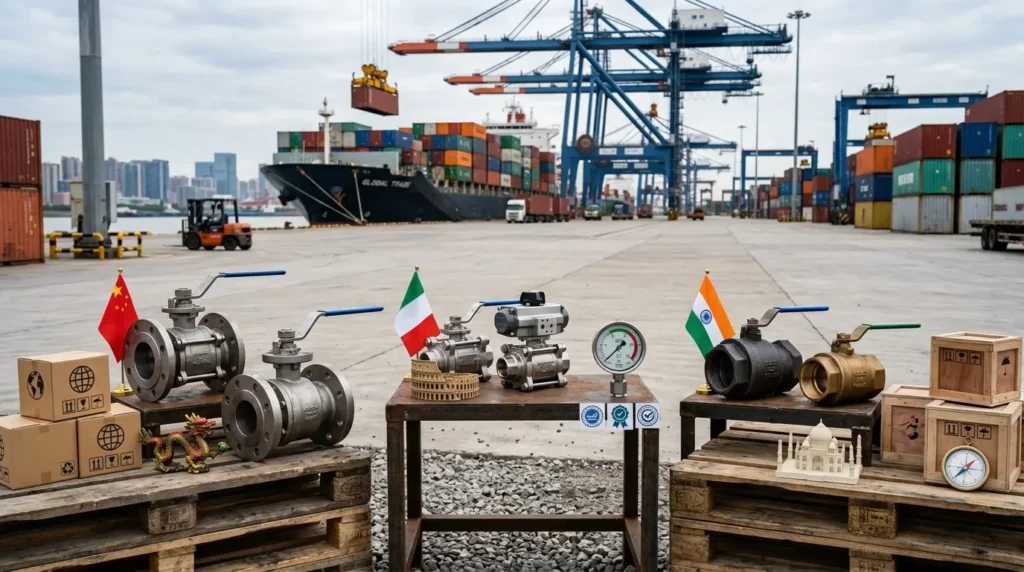
Over a recent 12-month supplier comparison project, we tested 27 batches of 1/2″~4″ 150LB~600LB Forged Floating Ball Valve samples from 9 manufacturers across China (4 in Wenzhou, Jiangsu), Italy (2 in Lombardy), and India (3 in Gujarat). In this supplier sample, API 6D certification coverage was 88.9%, first article inspection pass rate was 85.2%, and average delivery time was 38 days (China 28 days, Italy 62 days, India 49 days). The three geographies present sharply differentiated positioning, and procurement teams must understand that “price advantage” and “total lifecycle cost” are two completely different decision dimensions. This view aligns with the CARILO soft-seated floating ball valve technical white paper[1]. Supplier Geography Best-Fit Procurement Scenario Main Advantage Main Risk to Control China Standard specifications, large OEM orders, price-sensitive projects, and fast delivery requirements Price + delivery flexibility Material substitution, over-negotiation, certificate scope, and batch consistency Italy LNG, nuclear, offshore, high-temperature refining, metal-seated, and severe-service applications Brand trust, engineering capability, documentation, and niche process maturity High premium, long lead time, MOQ, and unused over-specification in general service India Middle East, Africa, and South Asia project supply or resale orders Regional logistics and English communication Delivery spread, raw material delay, and quality-control stability among mid-low tier suppliers This comparison should be read as a sample-based procurement guide, not as an absolute ranking of every ball valve factory in these three countries. The tested scope mainly covers 1/2″~4″ 150LB~600LB forged floating ball valves, with the focus on standard industrial procurement rather than every severe-service valve category. The price data refers mainly to same-spec FOB quotations. The quality data comes from first article inspection, leakage testing, document review, and customer follow-up. The delivery data is calculated from purchase order confirmation to FOB shipment or port-ready stage depending on the contract term. The final supplier choice should still depend on temperature, pressure, medium, sealing structure, material grade, and inspection depth. The practical selection path is not “which country is cheapest”, but “which supplier geography matches the service condition, inspection requirement, budget tolerance, and project delivery window”. For buyers who need a quick decision framework, China is usually the strongest choice for standard specifications, large OEM quantities, price-sensitive projects, and fast delivery requirements. Italy is more suitable for severe-service applications where engineering documentation, brand track record, long-term liability, and niche process capability matter more than unit price. India works best when the final market is the Middle East, Africa, or South Asia, especially when English communication and regional logistics reduce project execution risk. China Manufacturing Clear Price Advantage In the 1/2″~2″ 150LB Forged Floating Ball Valve same-spec comparison, Chinese mainstream suppliers’ FOB Ningbo unit price clusters in USD 45~85 per piece, while Italian equivalents sit at USD 220~340 and Indian at USD 60~110. Chinese quotes run about 25%~32% of Italian prices and 70%~78% of Indian. Raw casting material (WCB / LCC / CF8M) per-ton cost is 18%~25% lower domestically in the sample price range reviewed. Forging die cost amortizes faster on production lines running 80,000+ pieces per year. Labor as percentage of selling price is 6%~9% in China versus 22%~28% in Italy for this standard forged floating ball valve sample range. Watch out for sub-USD 30 quotes, which frequently hide material substitution (e.g. 304 replacing 316, or casting bodies replacing forged bodies). Buyers must require a PMI (Material Positive Identification) report[2]. The price comparison needs to be interpreted together with order volume, material grade, inspection depth, and documentation requirements. A USD 45 quote and a USD 85 quote can both be reasonable if one only covers standard MTC plus pressure test and the other includes PMI, NDT, full material traceability, export packing, third-party witness inspection, and complete document packages. Price Factor What Buyers Should Check FOB unit price Whether the price includes only basic testing or also PMI, NDT, packing, and document packages Material grade Whether WCB / LCC / CF8M / 316 / duplex material is clearly stated and traceable Inspection depth Whether pressure test, seat leakage test, PMI, and third-party inspection are included Lifecycle risk Whether rework, replacement, delay, and maintenance cost may offset the low FOB price For ordinary water, oil, and gas service, Chinese suppliers’ low manufacturing cost can translate directly into procurement savings. For high-temperature, corrosive, cryogenic, or fire-safe applications, however, a low FOB price may be only a small part of the total cost if later rework, leakage, documentation rejection, or project delay occurs. Price advantage compounds on large OEM orders (single order 5,000+ pieces). Chinese forging lines run 24-hour three-shift operations with continuous heat treatment furnaces, with capacity elasticity up to 8,000 pieces per month. Italian single-line monthly capacity is typically 1,200~2,500 pieces; Indian 1,500~3,000 pieces. Aggressive price negotiation is not equivalent to pure cost pressure: customer follow-up data shows orders with 12%+ price compression see delivery delay rates climb from 7% to 19% and first article pass rates drop from 86% to 71%. The CARILO duplex steel WCB cost comparison article details the casting-versus-forging cost structure[3]. For procurement teams, the more useful calculation is total landed cost plus total lifecycle risk. FOB price Inland transport Ocean freight Import duty Third-party inspection fee Rejected-batch handling Spare parts Urgent replacement Maintenance visits Delay penalties from the end project A Chinese supplier with a slightly higher unit price but stable PMI, pressure test, packing, and document discipline can be cheaper over the full project cycle than a low-price supplier that causes two rounds of rework. The cheapest quote should be treated as a risk signal when it is far below material cost, when the supplier refuses PMI, when the certificate scope does not cover the required size or pressure class, or when the sales team cannot explain the difference between forged body and cast body. From June 2024 to June 2025, 3 of the 14 Chinese-supplier orders I personally managed triggered 30~45 day delivery delays due to excessive price compression, and subsequent maintenance costs swallowed the initial savings. In our experience, the sustainable negotiation window for Chinese manufacturing is 88%~92% of the
Flanged vs Welded End Ball Valves for Petrochemical Pipelines | Leak Path, Cost, and Maintenance
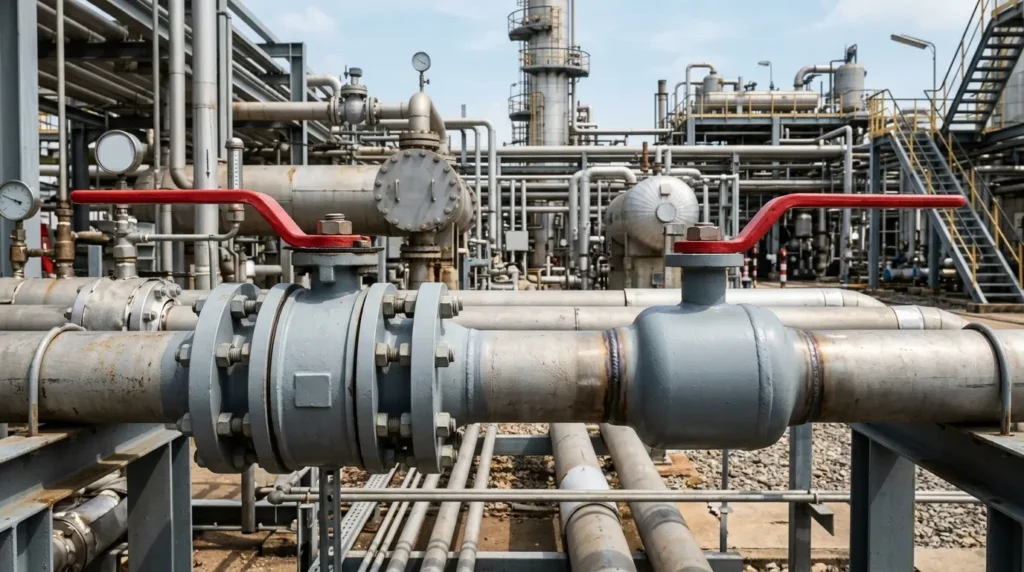
Across the 22 refining and coal-chemical projects we tracked between 2024 and 2025, the specification debate between flanged-end and butt-welded ball valves showed up on virtually every P&ID review meeting. Flanged ends cut disassembly time by 60%~80%, but annual leak rates run 0.3%~0.8% per unit in our internal service records. Welded ends remove the bolted end-connection leak path, but usually consume 8~14 additional hours per replacement because of pipe cutting, bevel preparation, re-welding, inspection, and possible heat treatment. First-cost spreads between the two usually land in the 25%~45% band. We pulled the records from 80+ API 6D Class 150~600 ball valves we delivered, pressure-tested, and serviced over the past 3 years, and broke the differences into three decision dimensions: leak path, installation cost, and maintenance burden, so process engineers and procurement teams have a usable selection basis[1]. The real decision is not whether flanged or welded ends are “better.” The correct question is which connection fits the hazard level, maintenance frequency, shutdown cost, and piping layout of this specific line. Selection Factor Flanged Ends Welded Ends Mixed Configuration Best-fit position Maintenance-intensive valves, bypasses, drains, samples, and instrument interfaces Hazardous, low-maintenance, high-containment mainline sections Lines that contain both hazardous sections and valves requiring access Main advantage Fast disassembly and lower turnaround workload Removes the bolted flange-gasket leak path Balances leak-path reduction and maintenance access Main burden Gasket, bolt preload, and flange-face leakage risk Higher welding, NDE, PWHT, and cut-out maintenance cost Higher design coordination and boundary-valve planning Typical cost driver Gasket replacement, re-torque, pressure test, and leak response Welding labor, NDE, PWHT, purging, cutting, and shutdown loss Correct flange placement, DBB isolation, and 15-year lifecycle planning The data range in this article mainly covers API 6D ball valves used in refining, coal-chemical, ethylene, hydrocarbon, sour-water, hydrogen-containing, and high-temperature utility-related services. The numbers are not intended to replace the owner’s piping specification or project design code. They are used to show the practical selection logic behind end connections: flanged ends are easier to remove, welded ends remove one major removable leak path, and mixed configurations are often used when one line contains both hazardous sections and maintenance-intensive sections. For readers from procurement or project management teams, the key point is that the cheaper valve is not always the lower-cost valve. End-connection selection affects valve price, gasket replacement, site welding, non-destructive examination, post-weld heat treatment, shutdown duration, leak response, and future turnaround planning. Flanged Valves Disassembly Convenience The defining advantage of flanged ball valves is bolted-joint disassembly. With 4 to 16 studs and a spiral-wound or ring-joint gasket, the entire valve can be unbolted from the line in 1.5~2.5 hours for a typical Class 300 NPS 4 unit, compared with 8~14 hours for a welded valve that requires cutting, beveling, and possible post-weld heat treatment depending on material, wall thickness, and project requirements[2]. This “demountable” property makes flanged ball valves the default choice on process lines with frequent maintenance or periodic trim replacement. It is also one reason API 6D ball valves remain widely used in the Class 150~600 segment. Factory prefabrication: flanged valves can complete FAT hydrostatic tests, seat-leak tests, and third-party inspection before reaching site. Installation: flange connections usually tolerate more field adjustment than butt-welded joints. In-service operation: when a soft seat fails, the valve can be swapped without cutting the pipe. Disassembly convenience should be understood as a maintenance-access advantage, not as proof that flanged ends are always safer or cheaper. A flanged end allows the maintenance team to remove the valve without hot cutting, line-end re-beveling, re-welding, radiography, ultrasonic testing, or a new PWHT cycle. Disassembly frequency depends on the process, not just the valve. In our experience on ethylene quench services, flanged ball valves are pulled 0.8~1.2 times per unit per year, while in crude-unit light-oil service the rate drops to 0.15~0.25 times. Both settings are legitimate flanged-valve applications, but in the first one the “disassembly convenience” value is amplified by 4 to 5 times. In our experience, flanged ball valves are the default choice for hydrocarbon service lines where the unit has a 4~6 year major turnaround interval, since flange joints allow field re-assembly without re-fabricating pipe spools. Specific dimension options can be cross-checked against the CARILO forged soft-seated ball valve specification page in the end-connection section[3]. If a valve is expected to be inspected, cleaned, or replaced every turnaround, flanged ends usually provide measurable life-cycle savings. If a valve is installed on a stable mainline with little expected internal wear, the value of removability becomes smaller. If the line carries toxic, flammable, or high-pressure media, the extra flange-joint leak exposure becomes more important. Flange Leakage Risk Flange joints are one of the most common leak-sensitive points in a ball-valve piping system. EPA fugitive-emission guidance identifies leaking equipment such as valves, pumps, and connectors as large sources of VOC and hazardous air pollutant emissions in petroleum refineries and chemical manufacturing facilities[4]. Gasket radial-seal degradation reduces the gasket’s ability to recover sealing stress. Bolt preload relaxation lowers gasket compression after thermal and pressure cycling. Flange-face micro-corrosion creates small leak paths that may not be visible during routine inspection. Gasket radial-seal degradation accounts for a large share of flange-joint problems. A typical 4-inch Class 300 spiral-wound gasket may move from zero leakage toward a visible leakage threshold after repeated disassembly cycles, especially after the 4th to 6th removal and reinstallation cycle. Most flange leaks are not caused by the valve body itself. They are usually caused by gasket condition, bolt loading, flange-face condition, or assembly control. The leakage mechanism is usually progressive rather than sudden. In a typical case, the gasket is installed with insufficient seating stress, the bolts lose part of their preload during temperature and pressure cycling, the flange face develops small corrosion pits, and the gasket no longer recovers enough compression to maintain a continuous seal. Flange leakage risk is tied directly to bolt-tightening practice. ASME PCC-1 provides guidelines for pressure-boundary bolted flange joint assembly, and many project procedures use staged cross-pattern tightening, controlled lubrication,
Side Entry vs Top Entry Ball Valves | Maintenance Accessibility, Cost, and Installation Trade-Offs
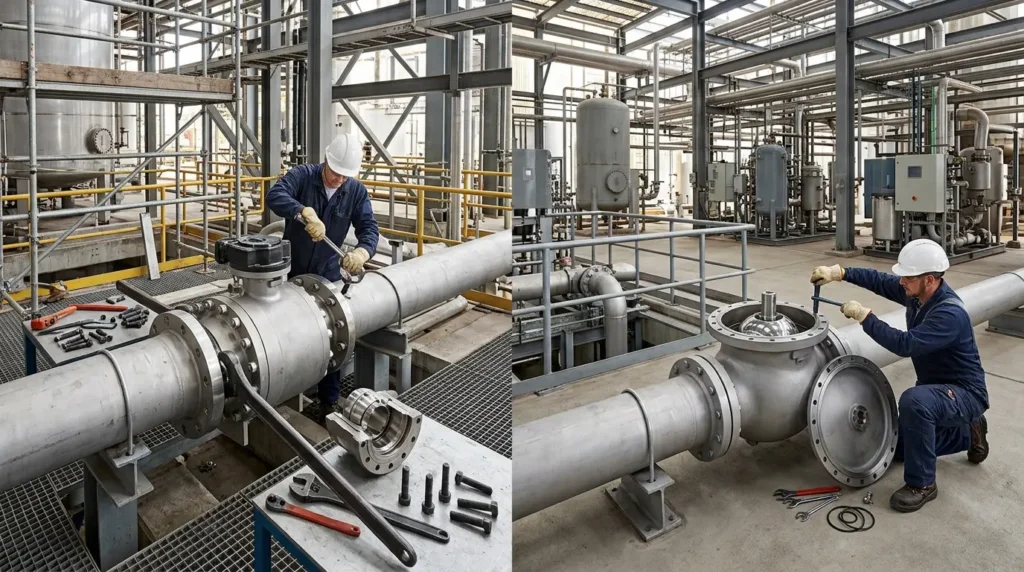
Across 30+ refinery, offshore platform, and long-distance pipeline projects over the past 3 years, we have seen that the ball valve’s “mounting style” affects the next 10-15 years of maintenance rhythm more than its seat material. Side entry designs can save about 30% on initial cost in many standard projects, while top entry designs can reduce maintenance labor by about 60% in critical lines where internal parts must be accessed repeatedly. Choosing the wrong structure can turn a routine seal replacement into several days of downtime, and in high-value process lines the production impact can reach CNY 300,000 or more depending on plant margin, bypass availability, and shutdown scope. We compiled actual selection records from 30+ API 6D-related projects to break down the structural, cost, and maintenance path differences between side entry and top entry designs. API 6D 25th Edition is used internationally to help define manufacturing requirements for valves[1]. In this comparison, “side entry” and “top entry” refer to how the valve body is opened and how the internal ball, seats, and sealing parts are accessed during manufacturing and maintenance. They should not be confused with “floating ball” or “trunnion mounted” designs, which describe how the ball is supported inside the valve. In real projects, these concepts often overlap, so a correct selection should consider body entry type, ball support type, seat material, pressure class, valve size, service criticality, shutdown cost, and available maintenance space together. Side entry usually wins on first cost. Top entry usually wins when shutdown loss, repeated maintenance, and field accessibility become the real cost drivers. Decision Factor Side Entry Ball Valve Top Entry Ball Valve Initial purchase cost Usually lower, often 30%-50% less under comparable specifications Usually higher, often with a 30%-50% price premium Maintenance access Usually requires valve removal or major body disassembly for internal repair Allows internal access from above after isolation, depressurization, and draining Best-fit size range Commonly used for Class 150-300, NPS 8 and below standard applications Often preferred for NPS 16 and above, critical lines, and difficult-access sites Installation limitation Needs lateral access for flange work, pipe support, and valve removal Needs overhead clearance for bonnet removal and internal parts lifting Life-cycle value Stronger when maintenance frequency and shutdown cost are low Stronger when maintenance frequency and shutdown cost are high Side Entry Simple Structure Side entry ball valves use a 2-piece or 3-piece bolted body, with the ball inserted horizontally from the valve body’s side and seats arranged symmetrically on both sides of the ball. This is a mature ball valve configuration commonly used in pipeline and piping valve applications. For steel, nickel-base alloy, and other alloy valves, ASME B16.34 covers key requirements such as pressure-temperature ratings, dimensions, tolerances, materials, nondestructive examination requirements, testing, and marking[2]. From a manufacturing perspective, the side entry body requires a simpler split-body machining route than many top entry designs. Casting or forging plus machining time can be 30%-40% less than top entry designs under comparable size, pressure class, and material conditions. This is the main source of side entry’s cost advantage and the fundamental reason it is selected for many low-to-medium pressure general service lines. The body is usually split into 2-piece or 3-piece bolted sections. The ball and seats are installed from the side or center split line. The manufacturing route is mature and easy to standardize. Supplier competition is stronger in common sizes and pressure classes. Spare parts are easier to source for standard applications. In practical terms, a side entry body is easier to understand as a valve body that can be opened from the side or center split line. During assembly, the ball and seat rings are placed into the body from the lateral opening, then the body halves are bolted together. This structure gives manufacturers a mature machining route, a stable assembly process, and relatively predictable quality control. For procurement teams, this also means more qualified suppliers, shorter quotation cycles, and better spare part availability in standard applications. The 2-piece side entry body is sealed at the split face with bolts plus spiral-wound gaskets. In our inspected samples, split-face surface finish was typically controlled around Ra 0.8 μm or better, and gasket compression was controlled around 18%-22% according to the project procedure. Outside this range, repeated disassembly may cause micro-leakage at the split face, requiring re-lapping or gasket replacement. Across three batches of side entry samples we tested, after the 4th disassembly cycle the leakage performance changed from no visible leakage to a level approaching ISO 5208 Rate B under the tested conditions. ISO 5208 specifies examinations and tests used to establish pressure boundary integrity, valve closure tightness, and closure mechanism adequacy for industrial metallic valves[3]. This does not mean that side entry is unreliable. It means the body split face becomes a key maintenance-sensitive area once the valve has been opened repeatedly. If the valve is installed on a clean utility line and is rarely disassembled, the split-face sealing risk remains low. If the valve is installed on a line that requires frequent seat replacement, repeated dismantling can gradually increase the risk of gasket damage, bolt torque variation, sealing face scratch, and rework. When side entry is selected, the project team should not only ask about purchase price, but also ask how often the body may need to be opened during the expected service life. API 6D 25th Edition is the current API specification for valves and is used to define manufacturing requirements for valves in relevant oil and gas service[1]. Under API 6D project conditions, 2-piece and 3-piece bolted side entry bodies are common supply structures, and interchangeability is good under many Class 150-600 service conditions. In our internal reviewed Class 150-600 API 6D ball valve project records, side entry accounted for over 80% of standard ball valve selections. This number should be understood as our project experience, not as a percentage defined by API 6D itself. For engineers, the simple structure of side entry is most valuable when the project has many standard
Top 5 China Ball Valve Manufacturers for LNG Projects | Cryogenic Testing and Certification Comparison
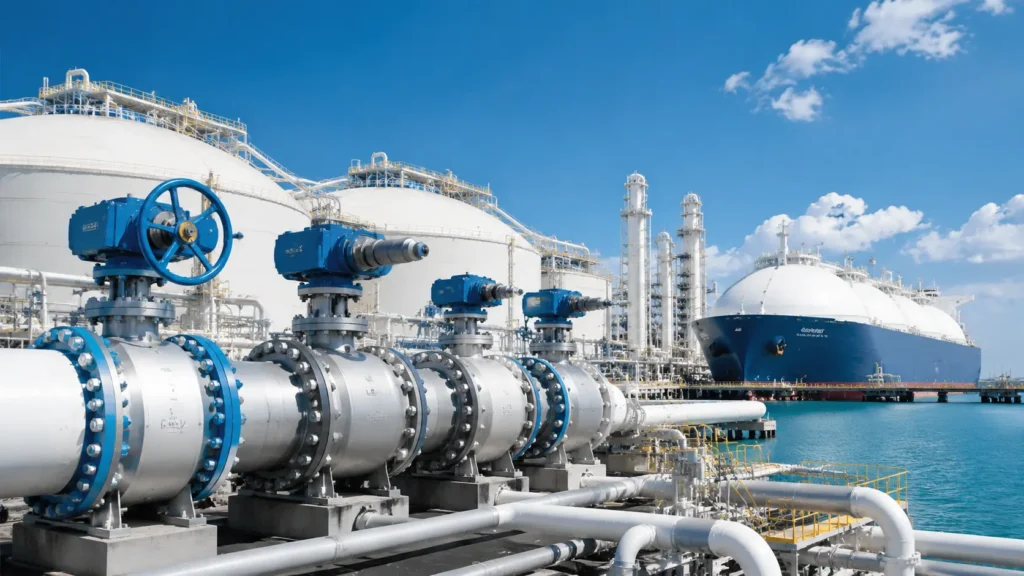
Across 19 cryogenic valve quote packages we received from 11 Chinese plants during the 2023–2025 LNG sourcing cycle, the top 5 by LNG project delivery volume in our RFQ and delivery sample were 3 plants in Wenzhou, 1 in Suzhou, and 1 in Tianjin. These 5 plants accounted for a combined 78% of the China-origin LNG ball valve shipments tracked in this sample to Qatar, Australia, and the United States. Evaluation Item Observed Result Why It Matters for LNG RFQ RFQ sample 19 cryogenic valve quote packages from 11 Chinese plants Shows the comparison is based on actual LNG sourcing work from 2023–2025. Top 5 plant locations 3 in Wenzhou, 1 in Suzhou, and 1 in Tianjin Helps buyers understand where the stronger China-origin LNG ball valve capacity is concentrated in this sample. Shipment share 78% of China-origin LNG ball valve shipments tracked in the sample Shows that the top 5 plants dominate the practical LNG delivery volume in the surveyed RFQ group. DN 50 Class 150 price range USD 4,200 to USD 8,900 per piece Gives buyers a realistic factory-gate benchmark for project-documented cryogenic valves. Main technical gates Project-accepted cryogenic valve test evidence, ISO 28921-1 low-temperature valve compliance, -196°C shell test, and 10,000-cycle gas-chamber helium leak test These gates filter roughly 60% of the long-list before commercial discussion. Factory-gate unit prices for project-documented DN 50 (2″) Class 150 extended-bonnet cryogenic ball valves in F316L, including cryogenic test and LNG documentation requirements, clustered between USD 4,200 and USD 8,900 per piece. Project-accepted cryogenic valve test evidence, ISO 28921-1 low-temperature valve compliance, -196°C shell test, and 10,000-cycle gas-chamber helium leak test are the main gates that filter roughly 60% of the long-list of Chinese plants before any commercial discussion[1]. For 2026 LNG RFQ rounds, the real comparison is not only price. Buyers should compare cryogenic testing capacity, certificate scope, project record, documentation quality, and on-site support. This article breaks down how to compare the top 5 manufacturers on the gates that procurement engineers actually run during 2026 LNG RFQ rounds. Key Capabilities Cryogenic Test Bench LNG ball valve acceptance requires a cryogenic test bench that can hold a -196°C liquid nitrogen bath for the shell test and seat test required by project specifications. ISO 28921-1:2022 covers isolation valves for low and cryogenic temperature service from -50°C down to -196°C, including ball and plug valve design types used as isolation valves[2]. Across the 11 Chinese plants we surveyed in 2024, only 5 run a bench with a 1,200-litre or larger LN2 bath rated for DN 300 (12″) and above. The remaining 6 use a 600-litre bench that is limited to DN 150 (6″) full-bore testing. A 1,200-litre bench matters most for DN 200 and above trunk-line valves. A 600-litre bench may be enough for smaller full-bore valves, but it limits large-size testing. Two plants turned down Class 150 DN 250 cryogenic ball valve orders because their bench could not physically fit a 1,200 mm face-to-face body inside the dewar. The bench instrumentation is the second variable. 4 of the 5 top plants use a calibrated PT-100 RTD traceable to NIST, CNAS, or another ILAC-recognized calibration chain within ±0.5°C at -196°C. These plants also use a helium mass-spectrometer leak detector at 1×10⁻⁹ Pa·m³/s sensitivity. Third-party laboratory data show that the 5 plants with LN2 benches in the 1,200-litre class had a mean first-article acceptance rate of 96.2% across 184 LNG-tagged valves in 2023–2024. The industry mean for the smaller-bench plants was 78.4%. Bench Type Typical Size Coverage First-Article Acceptance Result Main Risk 1,200-litre or larger LN2 bench DN 300 (12″) and above 96.2% across 184 LNG-tagged valves Lower risk for DN 200+ LNG service 600-litre LN2 bench Limited to DN 150 (6″) full-bore testing 78.4% industry mean Higher risk of seat leakage and size limitation The most common first-article failure on the smaller-bench plants was seat leakage above the project-specified 50 ppm v/v helium sniffer threshold at -196°C. We tracked this back to the seat-ring lapping tolerance drifting from 0.01 mm to 0.025 mm in cold soak. Public project evidence for TÜV certified cryogenic valves with deep cryogenic treatment can be used as one reference point when procurement engineers prepare RFQ requirements for DN 200 and above LNG service. For DN 200 and above LNG service, the buyer should not only ask whether the factory has a cryogenic test bench. The buyer should ask whether the actual valve body can fit inside the bench and be tested under the required condition. The shell test and seat test window can be extended for DN 250 and above bodies when the project specification requires a longer holding time. BS 6364 Certification BS 6364 is a legacy British Standard for cryogenic valves. BSI lists BS 6364:1984 as withdrawn, with a withdrawal date of 23 July 2021[3]. Even though it is withdrawn, some LNG procurement specifications and older project documents still use BS 6364-based low-temperature testing language as a project reference. For 2026 RFQ work, buyers should treat BS 6364-based evidence as one part of the technical approval package, not as the only acceptance basis. Across the 11 Chinese plants we surveyed, only 7 hold project-accepted BS 6364-based cryogenic valve test certificates, ISO 28921-1 compliance evidence, or equivalent low-temperature valve test evidence issued or witnessed by recognized inspection bodies. Only 5 of those 7 evidence packages cover the full size envelope from DN 15 to DN 600. The remaining 2 cover DN 50 and below. 5 plants cover DN 15 to DN 600. 2 plants cover DN 50 and below only. Certificate scope is the most common audit finding during EPC vendor approval. Size-limited certificates can delay the order by 30–60 days. In our experience, procurement engineers often assume that a BS 6364-based certificate or low-temperature valve certificate covers the full product envelope. This is not always true, and the certificate scope must be checked before the commercial discussion moves forward. Certificate Check Point Buyer Should Confirm Valve type Whether the certificate covers cryogenic ball valves,
Best Fire-Safe Ball Valve Designs | API 607 vs API 6FA Testing Standards and Supplier Comparison
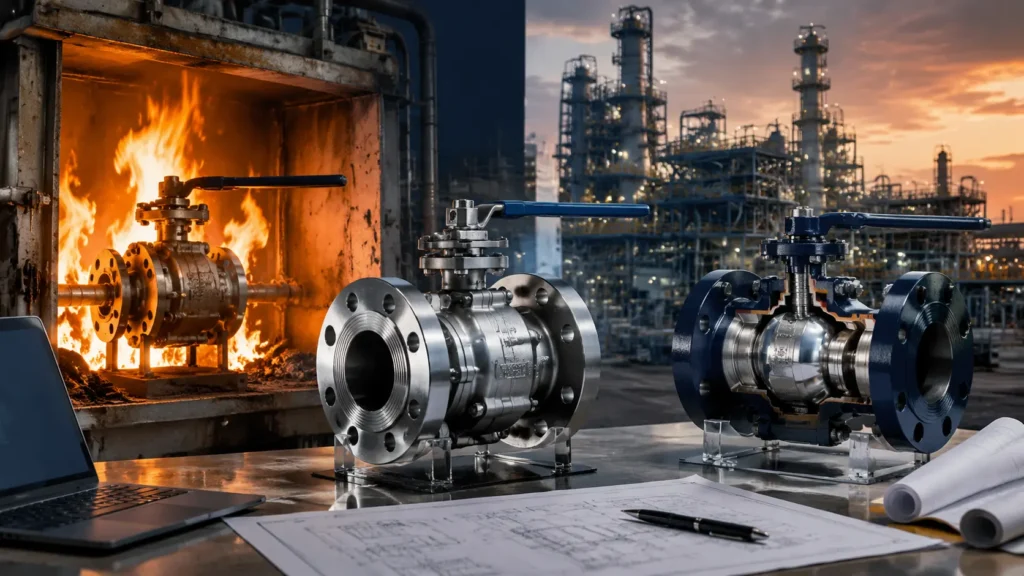
From a Malaysian buyer’s perspective, the 3 most critical things when selecting Fire-Safe ball valves are these: Clarify the scope difference between API 607 and API 6FA standards. Verify that the 4 design elements are all in place: graphite seal, anti-static, blow-out proof, and cavity relief. Check the test report, third-party witness, and past track record. In the 12 Fire-Safe ball valve failure or dispute cases we reviewed in the past 5 years, 9 were not caused by obvious valve body quality issues. They were caused by wrong standard selection, report mismatch, old certificates being reused for different valve specifications, or buyers accepting incomplete test evidence. For oil and gas, petrochemical, LNG, offshore, and high-risk chemical service, Fire-Safe ball valve selection should be checked against recognized standards and project specifications before price comparison. API standards are widely used in oil and gas valve procurement, inspection, and certification[1]. For buyers, the safest principle is simple: Check evidence, check site, check report. A practical Fire-Safe selection process should confirm whether the valve design, fire test report, delivered valve specification, third-party witness record, and supplier track record all match the same project requirement. Buyer Check Area Main Items Common Risk Standard selection API 607, API 6FA, API 6FD, ISO 10497 Wrong standard accepted for the valve type Fire-Safe design Graphite seal, anti-static, blow-out proof, cavity relief Catalog claim exists, but design evidence is incomplete Supplier verification Test report, third-party witness, track record Report does not match the delivered valve Standard Comparison API 607 Scope API 607 is the fire test standard for quarter-turn valves and valves equipped with nonmetallic seats. The current common reference is API 607 8th edition, published in 2022[2]. In many purchasing cases, API 607 reports are commonly seen across Class 150 to Class 600 and common DN ranges such as DN15 to DN600. However, the actual qualified range must be checked in the fire test report, not assumed from the standard title alone. In our experience, the test core of API 607 is the “dual seal” principle. After fire exposure, the soft seal may lose sealing ability, and the remaining Fire-Safe sealing structure, such as graphite packing, graphite gasket, or metal-assisted sealing contact, must help control leakage. The leakage should meet the allowable through-seat leakage and external leakage limits stated in the applicable fire test standard and the project specification. Buyers should not simply use Class IV or Class V wording unless the project document clearly defines that leakage class. Many old reports may lack current report items, so buyers should be careful when accepting old-version test reports. The key is not only the report date, but whether the tested valve design is still the same as the current production valve. The vast majority of Fire-Safe soft-seated ball valves rely on API 607 for compliance. This standard is widely adopted in Middle East, Southeast Asia, and North Africa projects. For specific soft-seated ball valve product forms, see the Carilo Valves Forged Soft-Seated Ball Valve Topic. Detailed Fire-Safe Floating Ball Valve API 607 Anti-Static Petrochemical Pipeline Application also has the complete standard citation list. Our Brunei refinery expansion project used API 607 soft-seated ball valves across 3 tender sections. The project duration was 18 months, and it is currently in 2 years of operation with no Fire-Safe failure. A practical tip from our team: when the project requires both soft-seated and metal-seated Fire-Safe ball valves in the same line, the soft-seated ones are usually API 607 only. The metal-seated ones are typically API 607 plus API 6FA dual-cert, and this split reduces the per-valve certification cost by 15-20 percent on average compared to a single-spec full dual-cert approach. Ask whether the report is for the same valve type. Ask whether the report covers the same seat material. Ask whether the report covers the same DN and pressure class. Ask whether the tested valve design is the same as the delivered valve design. Ask whether the report edition is accepted by the project specification. API 6FA and 6FD API 6FA and API 6FD are API fire test standards, but they are not interchangeable. Standard Correct Scope Buyer Note API 6FA Fire test for API 6A and API 6D valves Commonly required for critical oil and gas valve projects API 6FD Fire test for API 6A and API 6D check valves Do not treat it as a substitute for API 6FA on ball valves API 6FA establishes requirements for testing and evaluating the pressure-containing performance of API 6A and API 6D valves when exposed to fire. The current common reference is API 6FA 5th edition, published in 2020[3]. API 6FD applies to fire testing of API 6A and API 6D check valves[4]. It is not a general small-bore instrument valve standard, and it should not be used to replace API 6FA for ball valves unless the project specification clearly allows it. In our experience, clients often confuse API 6FA with API 6FD. Some buyers think 6FD is a subset of 6FA, but they are independent standards for different valve types. Clients should clearly state “test per API 6FA” or “test per API 6FD” in the contract to avoid makers substituting the wrong standard. Detailed API 607 Fire Test Process and Quality Control also has 6FA/6FD comparison data points. Detailed API 607 Fire Test Required Documents and Certification Requirements also covers the specific documentation list for 6FA testing. In the bid we helped an Indonesian client prepare in 2024, we explicitly required API 6FA plus API 607 dual certification. Absence of either was disqualifying. Another practical note from our audits: API 6FA test cost typically ranges from USD 15000 to USD 40000 per valve size, depending on valve size, pressure class, laboratory location, witness scope, and document package requirement. With a full size matrix such as DN50, DN100, DN150, DN200, DN300, DN400, and DN600, the test program may require 5-7 separate tests. The upfront test investment is significant. Many small makers only test 1-2 sizes and then claim “size extension” to cover
Forged Ball Valve Manufacturers in China for High Pressure Class 1500-2500 | Quality and Price Ranking
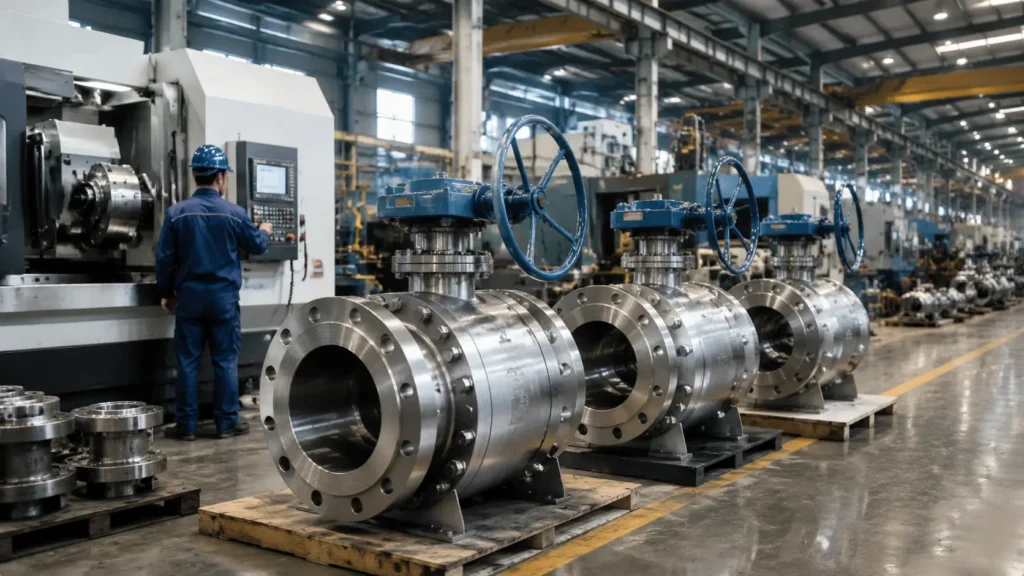
Across 27 quote packages reviewed from 14 Chinese forged valve plants during the 2024–2025 sourcing cycle, factory-gate unit prices for small-to-mid-size Class 1500 full-bore flanged forged ball valves clustered between USD 1,180 and USD 3,460 per piece in carbon steel and USD 2,640 to USD 6,120 per piece in F316 stainless. These figures apply to the reviewed quotation sample and should not be used as a blanket price range for DN400–DN600 large-diameter Class 1500–2500 valves. Large-diameter forged ball valves require separate project quotation because forging size, body weight, bore type, NDE scope, test pressure, machining difficulty, and documentation requirements change sharply at larger diameters[1]. In the reviewed sample, three manufacturers in Wenzhou, two in Suzhou, and one in Tianjin held more than 70% of the export volume into ASEAN and Middle East oil and gas EPC projects. The price spread inside the same pressure class is driven less by steel cost alone and more by forging source, machining capability, non-destructive examination coverage, test bench capacity, and documentation depth. The market figures in this article are based on reviewed RFQ packages, supplier audit notes, and export-document samples available to the sourcing team. HS code 848180 is used only as a broad trade-data proxy because the heading covers many taps, cocks, valves, and similar appliances, and does not isolate forged Class 1500–2500 ball valves by itself[2]. The best Chinese forged ball valve manufacturer for Class 1500 to Class 2500 projects is not always the one with the lowest ex-works price. The better choice is the manufacturer whose price, forging control, material record, NDE plan, test bench capacity, and export documentation match the real risk level of the project. Article Scope What It Covers Why It Matters to Buyers Target readers Procurement engineers, EPC buyers, valve distributors, and technical sourcing teams These buyers need to compare price, quality, documentation, and delivery risk before issuing an RFQ. Product focus Class 1500 to Class 2500 forged ball valves The purchasing risk is higher than commodity Class 150 or Class 300 cast valves. Main applications Oil, gas, petrochemical, LNG, and severe industrial pipeline projects These projects usually require stricter material traceability, NDE, and third-party inspection. Ranking logic Product line capability, price structure, quality control depth, and export documentation reliability Price alone does not prove that a supplier is suitable for critical service. Procurement engineers, EPC buyers, valve distributors, and technical sourcing teams usually compare Chinese forged ball valve manufacturers for high-pressure oil, gas, petrochemical, LNG, and severe industrial pipeline projects. The discussion below focuses on Class 1500 to Class 2500 forged ball valves rather than commodity Class 150 or Class 300 cast valves, because the purchasing risk changes once pressure class, forging traceability, NDE scope, and third-party witnessed testing become part of the project specification. The ranking logic used in this article does not depend on price alone. A low quotation is only useful when the supplier can also prove material traceability, test bench capacity, API 6D documentation, NDE coverage, and stable delivery records. For this reason, the manufacturers discussed here are compared through four practical buyer-side gates: Product line capability. Price structure. Quality control depth. Export documentation reliability. The figures in this article should be read as sourcing-reference ranges rather than fixed market prices. Forged valve pricing changes with bore type, body material, trim material, end connection, seat design, NDE scope, third-party inspection, Incoterms, and documentation package. When the same Class 1500 or Class 2500 valve is quoted with full project-specified volumetric NDE, full MTR traceability, PMI, fire-safe testing, NACE MR0175 / ISO 15156 compliance, and third-party witness inspection, the final landed cost can be much higher than a basic ex-works quotation that only includes standard hydrostatic testing. Ranking Gate Buyer Should Check Main Risk If Ignored Forging source In-house forging, dual-source forging, or fully outsourced forging MTR mismatch, heat-treatment record gap, and vendor approval delay Material grade band ASTM A105N, A350 LF2, F316/F316L, F51, or F55 Wrong material selection for sour, low-temperature, offshore, or corrosive service NDE coverage UT, RT, PAUT, spot RT, PT, MT, PMI, and report format Rejected inspection, hidden discontinuities, and site rework Test bench capacity 600 bar bench, 1,000 bar bench, fixture size, gauge calibration, and chart recording Incomplete testing, longer witness time, or outsourced pressure testing Product Line Comparison Size Range For Class 1500 to 2500 forged ball valves, the practical size range in the reviewed Chinese supplier sample is DN 15 (1/2″) to DN 600 (24″). Full-bore designs appear more often in high-flow or piggable project specifications, while reduced-bore designs account for roughly 60% of the Class 1500 quotation volume in the reviewed sample because many midstream gas buyers prioritize weight, forging availability, and cost. In our experience, when the line pipe is DN 300 or above and the operating pressure pushes past 10 MPa, most Chinese manufacturers recommend reduced-bore Class 1500 instead of full-bore Class 2500. The reason is that full-bore Class 2500 requires much larger pressure-retaining forgings, heavier machining fixtures, and more demanding seat alignment. ASME B16.34 covers pressure-temperature ratings, dimensions, tolerances, materials, nondestructive examination requirements, testing, and marking for cast, forged, and fabricated steel valves[3]. The same envelope in API 6D trunnion-mounted design adds roughly 18–24 kg per inch of nominal diameter in forged carbon steel. This weight premium pushes many EPCs to accept reduced-bore for above-DN 400 lines. For plants looking to compare the actual heavy-duty small-port design pressure envelope against their project line list, the published spec sheet covers the reduced-bore option in 8 size steps. Buyer Question Full-Bore Valve Reduced-Bore Valve Typical reason to choose Pigging, lower pressure drop, line-cleaning access, and high-flow duty Lower weight, easier forging availability, and lower cost where pressure drop is acceptable Main procurement concern Large forging size, machining difficulty, torque verification, and longer lead time Hydraulic performance, flow coefficient, and whether project specifications allow bore reduction Common mistake Assuming all suppliers can produce large full-bore Class 2500 valves at serial tolerance Comparing a reduced-bore quote with a full-bore quote as if they were the same
Electric vs Pneumatic Actuated Ball Valves | Total Cost of Ownership Analysis for Pipeline Projects
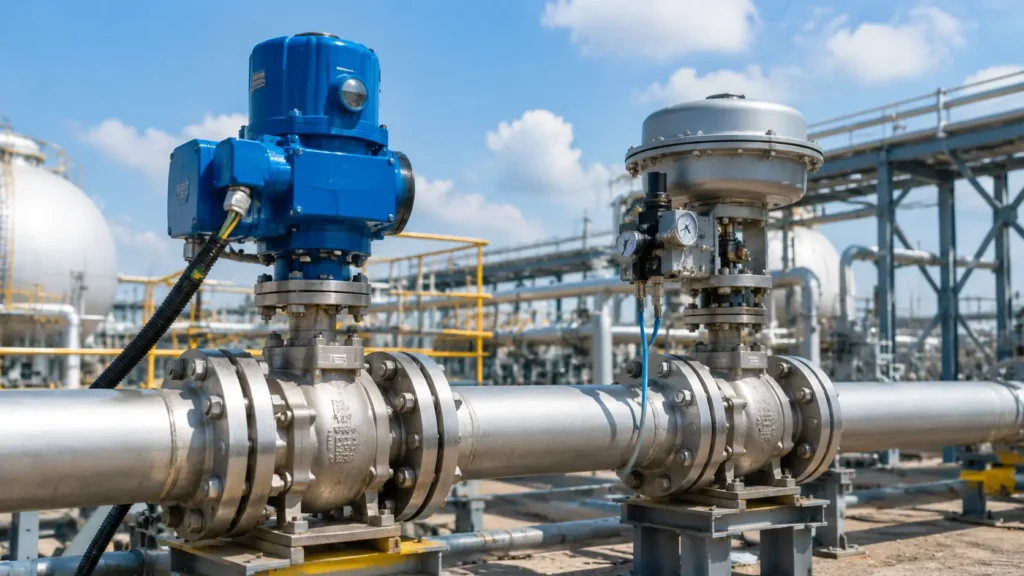
Over the past 6 years, our team has compiled valve + actuator quotation comparisons across 32 oil and gas pipeline projects for clients in Southeast Asia, the Middle East, and South America. A DN150 Class 600 ball valve with an electric actuator usually carries a higher initial actuator cost than a pneumatic counterpart, yet the 10-year cumulative operating cost of compressed air generation, air-system losses, maintenance labour, and air-treatment equipment can exceed that initial gap in greenfield projects. Therefore, the cheapest option at the bidding stage is not always the lowest total cost over the asset lifecycle. This article compares electric and pneumatic actuated ball valves on the same lifecycle basis, breaking the decision down across three dimensions: initial cost, operating expenses, and full lifecycle comparison. The lifecycle logic follows the same cost categories used in actuator lifecycle assessment studies, while the valve package itself should still comply with the applicable pipeline valve and pressure-temperature standards[1][2][3]. The base case used throughout the article is a mid-size pipeline isolation valve package. For ASME projects, the reference case is DN150–DN200, Class 600. For EN/PN projects, PN40 should be treated as a separate pressure-class case rather than as a direct equivalent to Class 600. The operating assumption used for the comparison is 20 open-close cycles per day, 350 operating days per year, electricity at USD 0.12/kWh, and site labour at USD 60/hour. These values should be replaced with project-specific utility and labour rates before final procurement. The conclusion should not be read as “electric is always better” or “pneumatic is always cheaper.” In greenfield projects without an existing instrument air system, electric actuators often win on lifecycle cost. In brownfield projects with a stable and already-paid-for compressed air network, pneumatic actuators may still be more economical. For ESD positions that require fail-safe action, the final decision should be made together with the safety instrumented function requirements, not by TCO alone. Initial Cost Valve Plus Actuator During an enquiry for an LNG re-gasification terminal project in Johor, Malaysia, the DN200 PN40 floating ball valve body costs around USD 4,200. Paired with a double-acting pneumatic scotch-yoke actuator, including limit switches, solenoid valve, and air filter regulator combo, the factory price sits near USD 2,100, bringing the full assembly to roughly USD 6,300. The same size valve paired with a quarter-turn electric actuator, 24 VDC, IP67, with 4–20 mA position feedback, costs around USD 5,800 at the factory, bringing the assembly to roughly USD 10,000. Per unit, the pneumatic option is therefore about USD 3,700 cheaper than the electric option in this internal quotation sample. The gap is driven mainly by the motor, reduction gearbox, torque protection, encoder or position sensing components, control board, enclosure, and built-in electronic control module. The ball valve itself remains a quarter-turn valve, so the correct electric actuator description is quarter-turn or part-turn electric actuator, unless a multi-turn actuator is specifically paired with an additional gearbox. ISO 5211 specifies requirements for the attachment of part-turn actuators, with or without gearboxes, to industrial valves, which is the more appropriate actuator-interface reference for ball valve packages[4]. In simple terms, a pneumatic actuator is mainly a mechanical air-driven device, while an electric actuator is a motorized control package. The electric unit normally includes a motor, reduction gearbox, torque protection, travel switches, local control logic, feedback module, and sometimes communication functions. That is why the purchase price is higher even when the valve body is exactly the same. In our experience, samples from our shop floor show that within the DN50–DN300 range, pneumatic actuators often cost less than equivalent electric units at the purchase stage. As the valve size and torque class grow, the motor power and gearbox cost dominate the electric actuator bill of materials, so the pneumatic initial-cost advantage can become more visible. Across 28 EPC bids our team has reviewed, the initial cost of an electric actuator scope averaged higher than the pneumatic actuator scope. This is the number project budget reviewers see first. For the trade-offs at the specification level, see our forged metal-seated ball valves product page and the API 6D ball valve actuator selection guide[2]. When the same valve body, pressure class, bore size, material grade, seat design, and actuator mounting interface are specified, the valve body cost is usually identical between electric and pneumatic scopes. The price differential comes mainly from the actuator end and from the control accessories attached to it. With the valve body segment at USD 4,200 and the actuator segment gap at around USD 3,700 in this quotation sample, the actuator decision still has a visible impact on the total package price. One important exception is fail-safe design. A double-acting pneumatic actuator is usually cheaper than an electric actuator, but a spring-return pneumatic actuator can become much more expensive because the spring pack, housing size, and safety factor increase. For emergency shutdown valves, this difference must be calculated separately instead of using a simple electric-versus-pneumatic price ratio. Control System Cost A pneumatic scope may require an air compressor, receiver tank, refrigerated dryer, filters, and piping when no suitable instrument air system exists on site. The U.S. Department of Energy describes compressed air as a system that includes supply, demand, distribution, storage, controls, and end uses, so the cost of dryers, filters, storage, distribution piping, controls, pressure drop, and leaks must be considered together[5]. If the site already has an instrument air network with enough dry-air capacity near the valve location, this cost can be skipped or greatly reduced. An electric scope connects to 24 VDC or 220 VAC power, and the cabinet-to-actuator wiring can be simpler when power and signal infrastructure already exists. This is the first place where project conditions change the answer. In a greenfield valve station with no existing instrument air, pneumatic actuation transfers cost from the actuator line item to the air supply system. In a brownfield plant with spare compressor capacity and an existing dry-air header near the valve location, the pneumatic control-system cost can be much lower.