Use valve sealant only when the valve has an injection system made for the problem you are dealing with. In practice, that usually means minor seat leakage, certain stem leaks, or routine sealant service on valves that rely on injected sealant. If the problem is a cracked body, leaking flange, broken seat, actuator fault, or unexplained high torque, sealant is not the answer.
| What You Find | What to Do |
|---|---|
| Minor seat leakage | Sealant may help if the valve has a seat injection system |
| Minor stem leakage | Use the stem injection system if the valve provides one |
| Valve is becoming harder to turn | Find the cause first; lubricant may be needed instead |
| Lubricated plug valve due for service | Follow the manufacturer’s sealant interval |
| Flange, body, bonnet, or structural leak | Do not treat it with normal valve sealant |
| Leak returns sooner after each injection | Plan inspection or repair instead of repeated injection |
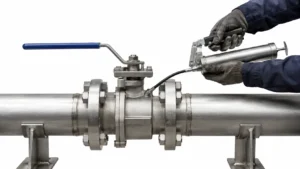
Inject for Minor Seat Leakage
Seat sealant is useful when the seat is still doing most of its job, but a small leak path has appeared between the seat and the ball or gate.
Common causes include:
- Sand trapped between the seat and ball
- Rust or pipe scale
- Welding debris
- Hard process deposits
- Small scratches
- Minor seat wear
A healthy seat makes continuous contact with the ball. Once a scratch cuts across that sealing band, fluid can pass through the small gap. If the valve has an approved seat-injection passage, sealant can fill that path and reduce the leakage.
In the field, injection has a better chance of working when:
- The valve reaches its full closed position.
- The seat still contacts the ball.
- The leak is small and stable.
- The damage is limited to a scratch, small gap, or minor wear.
- The injection passage is open.
Once the damage becomes mechanical rather than minor surface wear, the situation changes. A torn soft seat, badly eroded metal seat, deformed seat ring, damaged ball, or broken internal part cannot be rebuilt with sealant.
Seat material also changes the way damage develops. PTFE, PEEK, and metal seats behave differently under temperature, particles, pressure, and wear. The differences are covered in this PTFE, PEEK, and metal seat comparison.
If a ball valve leaks only when pressure comes from one side, do not assume both seats are bad. The cause may be one damaged seat, a rear seat seal, seat orientation, or the SPE/DPE arrangement. This one-direction ball valve leak diagnosis covers the main checks before sealant is injected.
Inject for Some Stem Leaks
Stem sealant only makes sense when the valve has a dedicated stem or packing injection point.
Typical signs are:
- Liquid around the stem
- Drops below the packing area
- Gas detected around the stem
- Process residue under the gearbox or actuator
- Repeated fugitive-emission readings
On many valves, the packing or stem seal is still the main long-term sealing part. The injected sealant works as a backup around small leakage paths. If the leak stops after injection, the worn packing underneath has not been restored to new condition.
Gas leakage is different from a visible liquid leak because there may be nothing to see. ISO 15848-1 covers testing of external leakage from valve stem or shaft seals and body joints for valves used with volatile air pollutants and hazardous fluids.[1]
Some lubricated plug valves work differently. On those designs, injected packing or sealant can be part of the normal sealing system, not just an emergency backup.
Use Lubricant for Torque Problems
A valve that is getting harder to turn may need attention, but that does not mean it needs sealant.
Possible causes include:
- Dry or aged lubricant
- Deposits or dirt
- Corrosion
- Seat swelling
- Bearing damage
- Gearbox problems
- Actuator problems
- Mechanical jamming
- High differential pressure
Breakaway torque is the turning force needed to start a stationary valve moving. If that force rises slowly over months or years, friction, deposits, or aging lubricant may be involved.
A sudden change should be treated differently. For example, if the same valve suddenly requires about 2× its normal operating torque, that is a fault worth investigating. The 2× figure is an example of a major change, not a universal alarm limit.
The cause may be a damaged part, foreign material, severe corrosion, abnormal pressure load, or a gearbox or actuator problem. Simply applying more force can make the damage worse.
If torque is normal when pressure is equalized but rises sharply under full differential pressure, process pressure may be a major part of the problem. The trunnion ball valve maintenance guide covers lubrication, torque changes, and common internal problems.
Match the Valve Design
Sealant practice changes with valve design, so one rule does not fit every valve.
Trunnion-mounted ball valves often have separate seat and stem injection systems, especially in larger pipeline sizes. Their internal layout can be seen in this guide to trunnion ball valve construction.
A forged soft-seated trunnion ball valve may therefore include maintenance features that are not present on smaller floating valves.
Floating ball valves use line pressure to push the ball toward the downstream seat. Many smaller floating designs have no field seat-sealant system. The practical differences are shown in the floating vs. trunnion ball valve comparison.
Lubricated plug valves may use injected sealant as part of normal operation. API 6D requirements for hydrogen service specifically require the lubricant/sealant used in lubricated plug valves to be validated for the valve’s rated temperature range.[2]
Gate valves are less predictable in this respect. Some have seat or stem injection fittings and some do not, so the exact model needs to be checked before any injection equipment is connected.
Many butterfly, globe, check, control, and small ball valves have no field sealant-injection system at all.
Do Not Inject for These Faults
Normal valve sealant is not a repair for structural or major mechanical damage.
- A cracked body or bonnet
- Severe corrosion or wall loss
- A failed flange gasket
- A badly damaged seat
- A broken ball, gate, plug, or stem
- A gearbox failure
- An actuator failure
A flange leak, for example, sits outside the seat injection path. Pumping seat sealant into the valve will not fix the failed gasket or flange faces.
The same caution applies to the valve body. If a pressure-containing part is damaged, stopping or reducing visible leakage does not prove the part is safe.
Confirm the Leak Source
The next step is to separate an actual seat leak from an external leak or a pressure reading that only looks like a seat problem.
| Condition | Meaning | Sealant? |
|---|---|---|
| Internal leakage | Fluid crosses a closed seat | Possibly |
| External leakage | Fluid escapes through the stem, body joint, flange, fitting, or body | Only some stem leaks |
| Apparent leakage | Unexpected pressure appears, but the source has not been confirmed | Diagnose first |
Unexpected pressure can come from another leaking valve, an open bypass, instrument tubing, trapped cavity fluid, thermal expansion, or another connected pressure source.
One pressure-gauge reading is not enough to tell you which seat is leaking.
Check Body-Cavity Pressure
On a trunnion ball valve, the space between the two seats is the body cavity. Pressure can build in this area even when both seats have not failed.
Possible causes include:
- Leakage through one seat
- Trapped liquid
- Temperature increase
- Pipeline pressure changes
- The seat’s cavity-relief design
Trapped liquid is especially important because it expands when heated and is difficult to compress. In a closed cavity, that can produce a large pressure rise.
API 6D Addendum 3 states that where liquid trapping is possible, automatic cavity relief is required. For temperatures up to 250°F (121°C), cavity-relief pressure must not exceed a differential pressure 33% above the applicable valve pressure rating.[3]
The 33% value is a specification limit under the stated conditions. It is not a field target for every valve.
SPE and DPE seats handle cavity pressure differently. An SPE seat can provide a pressure-relief path toward a lower-pressure side. A DPE seat loads toward the ball from either side and does not provide the same automatic cavity-relief behavior. See the SPE vs. DPE seat comparison.
If a DBB valve’s bleed port stays pressurized after venting, compare cavity pressure with the pressure on both pipe ends before blaming a seat. The common patterns are covered in DBB bleed-port pressure troubleshooting.
Confirm the Injection Port
The sealant has to travel through a specific route inside the valve:
Injection fitting → check mechanism → drilled passage → distribution groove → seat or stem sealing area
If the wrong fitting is used, the sealant may never reach the problem area.
Seat and stem fittings can look similar. Drains, vents, cavity-relief connections, and pressure-test fittings can also be mistaken for injection points.
Identify the fitting from the valve drawing or manual before connecting the injection gun.
If the correct port still refuses material, the passage may be blocked by:
- Hardened grease
- Dried sealant
- Dirt
- Rust
- Process deposits
Where contamination is suspected, the maintenance procedure may call for cleaning or flushing before fresh material is injected. Poor flushing can move debris across the seats and create more damage; see how to flush a pipeline without damaging ball valve seats.
Set the Correct Valve Position
Valve position affects where injected material can travel. Depending on the design, the required position may be fully open, fully closed, or another manufacturer-specified position.
The reason is simple: internal grooves and passages line up differently as the ball, gate, or plug moves.
Many pipeline isolation ball valves are designed for full-open or full-closed service. Leaving a standard on-off ball valve partly open can expose the ball and seat to concentrated high-velocity flow and increase erosion.
Ball valves built specifically for throttling or control are different.
Use the position stated for the exact valve model rather than choosing one by habit.
Match the Product to the Service
A sealant can be suitable for one service and completely wrong for another. Before injection, check:
- Process fluid: The sealant must tolerate the actual gas, liquid, chemical, or hydrocarbon.
- Temperature: Heat can soften or degrade some compounds; cold can make others too stiff to pump.
- Seal materials: Check compatibility with PTFE, PEEK, elastomers, O-rings, packing, and other internal materials.
- Purpose: Confirm whether the product is intended for cleaning, lubrication, seat sealing, stem sealing, plug-valve service, or emergency leakage control.
Different valve compounds may use different base oils, fillers, and thickeners. Mixing two products without confirming compatibility can change how the mixture behaves.
Do Not Use a Universal Sealant Quantity
The amount of sealant depends on valve size, internal passage volume, seat circumference, number of injection ports, product type, and valve design.
An 8-inch valve and a 24-inch valve differ by a factor of 3 in nominal diameter. That does not mean the 24-inch valve needs exactly three times as much sealant; its seat geometry, passage volume, and number of injection points may also be different.
Use the quantity given for the exact valve or compare it with that valve’s own maintenance history.
A changing pattern matters more than one number. If the same valve needs more material each time and the leak returns sooner, repeated injection is becoming less useful.
Read Pump Pressure and Leak Response Together
| What Happens | Likely Meaning |
|---|---|
| Pump pressure rises quickly and almost no material enters | Possible blocked fitting, check mechanism, or passage |
| Material enters normally but leakage does not change | Wrong port, wrong diagnosis, unsuitable sealant, or major damage |
| Material enters and leakage decreases | Sealant is probably reaching the leakage path |
| Leak stops but returns soon | The temporary seal is not stable |
Do not treat one pump-pressure number as a universal blockage limit. A large valve, small valve, long injection passage, different compound, and different line pressure can all produce different readings.
Verify the Result
The valve accepting sealant is not proof that the problem has been fixed.
For a seat leak, check whether the required isolation has actually returned. ISO 5208 specifies pressure tests for metallic valve pressure-boundary integrity and closure tightness, while product-specific requirements take priority where applicable.[4]
For a stem leak, check whether visible leakage or measured gas leakage has fallen to the required level.
For a lubrication job, compare breakaway torque and valve movement before and after the work and watch for abnormal tight spots.
If the approved procedure requires valve operation after injection, check the leak again afterward. Moving the ball, gate, or plug can redistribute sealant and change seat loading.
Track How Long the Seal Lasts
A single injection tells you whether the leak improved today. The time until the leak returns tells you much more about the valve’s condition.
| Injection Event | Leak-Free Period |
|---|---|
| First | 180 days |
| Second | 90 days |
| Third | 30 days |
| Fourth | 7 days |
These values are only an example, not service limits. The useful fact is the trend: the leak-free period has fallen from 180 days to 7 days. The valve is becoming less responsive to temporary sealing.
Record at least:
- Valve identification
- Injection point
- Product
- Amount injected
- Pump-pressure behavior
- Leakage before and after treatment
- Valve position
- Time until leakage returns
Base Maintenance on Actual Use
A single calendar interval makes little sense for valves that work under very different conditions.
A valve operated 4 times a year completes 4 cycles annually. A valve operated 4 times a day completes about 1,460 cycles per year. The second valve experiences 365 times as many operating cycles.
Maintenance frequency should also take into account:
- Valve design
- Process cleanliness
- Temperature
- Pressure
- Long idle periods
- Past torque changes
- Past leakage
HSE guidance for pressure systems states that maintenance should take account of equipment age, use, and the environment in which it operates.[5]
Stop Injecting and Plan Repair
Repeated injection stops making business and maintenance sense once the valve is no longer giving a stable result.
- The leak returns sooner after each injection.
- More sealant is needed each time.
- Sealant no longer reduces leakage.
- The valve cannot fully open or close.
- Operating torque remains abnormal.
- Internal damage is suspected.
- A pressure-containing part is damaged.
- The valve no longer provides the required isolation.
The valve’s role in the system matters as well. A utility valve with backup isolation does not carry the same risk as an emergency shutdown valve or a main isolation valve handling hazardous fluid.
Use Extra Care Under Pressure
Some valves are designed so approved sealant or lubricant can be injected while line pressure remains in the valve. That capability belongs to the specific valve design and procedure; it should not be assumed from the presence of a fitting.
Before pressurized injection, confirm:
- The correct fitting
- The correct valve position
- The approved sealant or lubricant
- Injection-equipment pressure rating
- Hose and coupler condition
- The applicable valve procedure
A rapid pump-pressure rise can come from a blocked fitting rather than high valve pressure. A blocked injection fitting should not simply be removed from a pressurized valve to clear it.
OSHA treats hydraulic, pneumatic, chemical, thermal, and other stored energy as hazards during servicing because unexpected energy release can cause serious injury or death.[6]
High-pressure fluid can also penetrate skin. HSE reports serious injection injuries at pressures above 100 bar (1,450 psi) and notes evidence of injury at pressures as low as 7 bar (101.5 psi). Suspected injection injuries require immediate professional medical treatment.[7]
Never use a hand or finger to search for leakage around a pressurized hose, fitting, or coupler.
Finally
Use sealant when the valve has a known seat or stem leak and the correct injection path. Use lubricant when friction is the real problem. Watch what happens during injection: rising pump pressure with little material points to a possible blockage, while a leak that returns sooner after each treatment points to worsening valve condition. An 8-inch valve and a 24-inch valve differ by a factor of 3 in nominal diameter, so one sealant quantity cannot fit both. A valve running 1,460 cycles per year also should not be maintained like one running only 4 cycles annually. Once temporary sealing stops giving a stable result, repair becomes the better choice.