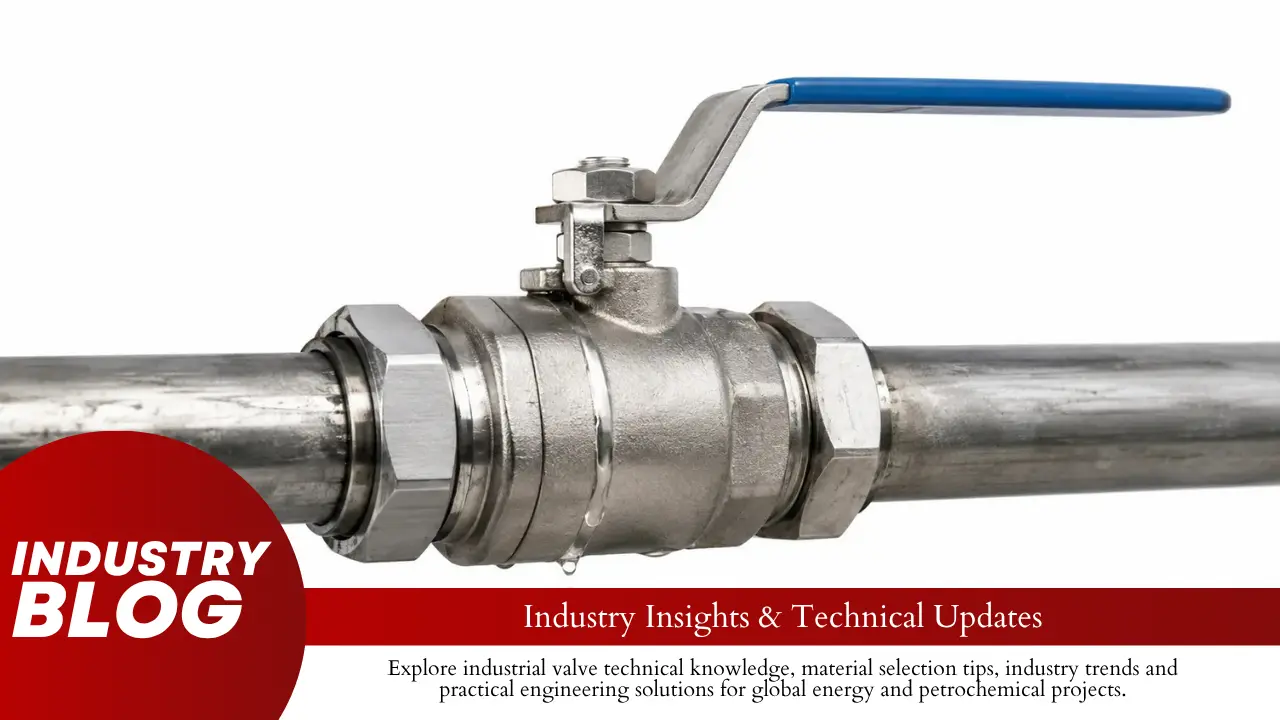
A ball valve spare parts list in a petrochemical plant can easily run into hundreds of material codes once size, pressure class, body material, trim material, seat design, actuator type, and service condition are separated. The parts that decide downtime, however, are usually a much smaller group. Inventory control should begin by separating shutdown-critical parts from ordinary consumables, long-lead insurance spares, and obsolete stock.
The most effective spare strategies for refinery, ethylene, PTA, and other petrochemical units are built around risk-based classification rather than purchase value alone. API 570 is useful as an inspection and maintenance reference for in-service piping systems, while ISO 14224 is useful for structuring reliability and maintenance data such as failure mode, failure cause, maintenance action, and repair time. Neither standard is an inventory formula, but both can support disciplined spare-parts planning when combined with plant-specific downtime cost, lead time, consumption history, and approved risk ranking[1][2].
In one internal spare-list optimization project, the planned valve-spare budget was reduced from 8.5 million to 5.8 million yuan, a reduction of about 32 percent. The saving came from removing duplicated non-critical stock, separating routine consumables from long-lead parts, and protecting the spares whose absence could delay restart after maintenance. Any shutdown improvement after such a change should not be attributed to inventory alone; it also depends on maintenance planning, supplier response, inspection findings, operating discipline, and the quality of interchangeability records.
Spare parts are not about quantity. They are about never running out of the parts that can stop production.
| Planning Item | Typical Planning Range | Meaning for Inventory Control |
|---|---|---|
| Total ball valve spare material codes | Hundreds of codes in a large plant | The full spare list must be filtered by criticality, consumption pattern, lead time, and interchangeability. |
| Critical spares share | A small minority of total codes in most reviewed lists | A limited number of parts usually drives most downtime exposure. |
| Budget reduction in one internal project | 8.5 million to 5.8 million yuan | About 32 percent lower planned spare budget after duplicate and low-risk stock was removed. |
| Core inventory metrics | Critical-part stockout count and shutdown-delay hours | Inventory success should be measured by availability risk, not by warehouse value alone. |
| Control basis | Risk ranking, consumption history, lead time, and approved supplier capability | Financial ABC classification is not enough for petrochemical valve spares. |

Spare Classification
What Counts as Critical Spares
Critical spares are not defined by price. They are the parts whose failure can prevent safe operation, delay restart, create unacceptable leakage, or force a process train to remain shut down. A low-cost sealing component in toxic, flammable, high-pressure, sour, hydrogen, or low-emission service can be more critical than an expensive part installed on a non-essential auxiliary line.
API 570 covers inspection, rating, repair, and alteration of in-service piping systems. It can help maintenance teams align spare planning with inspection findings and repair windows, but it does not prescribe a universal 8-to-72-hour spare coverage rule. Replacement windows should come from plant turnaround plans, emergency repair procedures, CMMS history, inspection recommendations, and the approved risk matrix for each line or valve position[3].
The following categories often appear on critical lists when installed in high-consequence service:
- Valve bodies and end connections
- Balls or other closure members
- Seats and seat rings
- Stems, drive keys, and stem-drive components
- Stem seals, packing sets, and body seals in hazardous or low-emission service
These categories should not be assigned the same risk level automatically. A valve body for a 14-inch Class 1500 special-alloy ball valve may have a much longer procurement cycle and higher capital exposure than a packing set. A packing set may still be critical if the valve is in volatile organic compound service, toxic service, hydrogen service, or an isolation position required for safe shutdown. The correct approach is to score each spare by failure consequence, replacement lead time, probability of demand, service severity, and interchangeability.
ISO 14224 provides a structured basis for collecting reliability and maintenance data in petroleum, petrochemical, and natural gas facilities. For valve spare planning, it is useful for standardizing fields such as equipment taxonomy, failure mode, failure cause, maintenance action, MTBF, and MTTR. A plant can use those fields to identify which valve positions repeatedly consume seats, packing, gaskets, actuator parts, or special trim[4].
| Critical Spare Type | Why It Can Be Critical | Inventory Priority |
|---|---|---|
| Valve body | Pressure-retaining part; replacement often depends on material grade, pressure class, casting or forging availability, and documentation package. | Highest for large, high-pressure, special-alloy valves. |
| Ball or closure member | Directly affects shutoff performance, coating integrity, torque, and leakage control. | High for isolation valves in shutdown-critical service. |
| Seat or seat ring | Wear, erosion, deformation, or coating damage can directly affect sealing performance. | High where leakage affects safety, emissions, product quality, or restart. |
| Stem and drive components | Failure can stop valve operation and may require disassembly or actuator removal. | High for motorized, emergency isolation, high-cycle, or hard-to-access valves. |
| Stem seal, packing, and body seal | May be ordinary consumables in low-risk service but critical consumables in hazardous, high-temperature, sour, hydrogen, or low-emission service. | Classify by service severity, regulatory impact, and replacement window. |
The most direct way to identify critical spares is to map the downtime loss curve.
- Define the credible shutdown or delayed-restart scenario for each valve position.
- Calculate the direct production loss for that scenario.
- Convert the loss into an hourly figure by dividing total shutdown loss by shutdown hours.
- Compare hourly loss with spare lead time, unit price, and probability of demand.
- Rank each spare by shutdown impact rather than purchase price alone.
For example, if a cracked-gas dryer upstream isolation valve delays restart for 48 hours and the direct production loss is 2.6 million yuan, the hourly loss is about 54,167 yuan. A spare that costs 80,000 yuan but prevents a 48-hour restart delay is not expensive in that context; it is a form of production-risk insurance.
Consumable Parts List
Consumable parts share three traits: predictable use, relatively low unit price, and repeat replacement. On ball valves, consumables usually concentrate in three locations:
- Packing or stem-seal sets
- O-rings, lip seals, anti-static seals, and auxiliary sealing elements
- Body-to-end, body-to-cover, body-to-bonnet, or flange gaskets, depending on valve construction
Consumables should not be stocked by intuition. They should be stocked by actual consumption rate, shutdown plan, minimum emergency buffer, and shelf-life control. For routine service, packing, O-rings, and gaskets can be managed as consumables. For sour, toxic, hydrogen, high-temperature, fire-safe, or low-emission services, the same parts should be marked as critical consumables because shortage can delay safe return to operation.
API 6D defines requirements for manufacturing valves used in pipeline and piping applications. In spare management, it is a useful reference when plants define what documentation should be retained for applicable valve components, including material certificates, heat numbers, pressure test records, marking, and traceability documents. It should not be used as a substitute for the plant’s own consumption forecast or warehouse min-max rules[5].
ASME B16.34 covers pressure-temperature ratings, dimensions, tolerances, materials, nondestructive examination requirements, testing, and marking for many steel, nickel-base alloy, and alloy valve constructions. It is the correct reference when checking pressure-temperature rating basis and valve construction requirements, but the temperature suitability of PTFE, PEEK, elastomer, graphite, or metal sealing parts must still be confirmed against the material datasheet, valve manufacturer’s design limits, and actual service condition[6].
One PTA facility stocked 200 packing rings based on intuition, but only consumed 87 in 12 months. At the same time, O-rings were stocked at only 30 pieces, and during an eighth-month batch replacement, 24 rings were drawn in one job. The packing shelf was overstocked, while the O-ring shelf was almost empty.
The plant changed the rule to the most recent 12-month maximum consumption, adjusted by a safety factor, shelf-life limits, and the next planned shutdown scope. Working capital tied to routine consumables fell, while emergency draws became easier to support. The important lesson was not the exact percentage reduction; it was the switch from fixed-quantity stocking to consumption-rate planning.
| Consumable Category | Inventory Method | Review Frequency |
|---|---|---|
| Packing rings | Use 12-month consumption history, next shutdown scope, service severity, and shelf-life rule. | Quarterly |
| O-rings | Plan by actual draws and batch-replacement events, not by a fixed shelf number. | Quarterly |
| Lip seals | Keep a short emergency buffer for unplanned replacement windows and check storage condition. | Quarterly |
| Body-to-end or body-to-cover gaskets | Review by shutdown work pack, historical consumption, material compatibility, and valve size mix. | Quarterly |
Long-Lead-Time Parts
Long-lead-time parts are components whose procurement cycle is much longer than the normal maintenance planning window. In petrochemical valve service, these often include special-alloy bodies, large high-pressure valves, special trim, metal-seated balls, large actuators, gearboxes, engineered sealing assemblies, and obsolete-model components.
Common materials and configurations include Monel, Hastelloy C276, duplex stainless steel, super duplex stainless steel, and large high-pressure valves above 12 inches at Class 1500 and higher. Lead time may range from several months to more than a year depending on casting or forging availability, heat treatment, NDE, PMI, machining capacity, coating, inspection hold points, pressure testing, and documentation requirements.
ISO 55001 provides requirements for an asset management system and focuses on managing assets through performance, risk, and cost over the life cycle. For long-lead-time valve parts, the practical application is to keep a risk register, identify no-spot-stock items, and prepare substitution, reserved-capacity, or framework-agreement plans before the part is needed[7].
NACE MR0175 / ISO 15156 should be applied carefully in sour service. ISO 15156-1 addresses metallic materials for H2S-containing environments in oil and gas production and natural-gas sweetening plants. Material suitability depends on the actual environment and cracking mechanism, including H2S exposure, pH, chloride, temperature, stress, hardness, and material condition. It should not be simplified into a chloride-only, hardness-only, or material-name-only rule[8].
For duplex stainless steel, the combination of high chloride, elevated temperature, sour conditions, and high stress may require a higher alloy grade or a different qualification route. When a super duplex body or special corrosion-resistant alloy component is required, casting or forging, heat treatment, NDE, PMI, pressure testing, and documentation can make spot purchase unrealistic. These parts should not follow a break-then-buy model.
- Build a forward-looking five-year demand forecast for long-lead items.
- Review the forecast twice a year with maintenance, inspection, operations, engineering, and procurement.
- Lock the first two years to specific suppliers where the risk justifies it.
- Use the remaining three years as optional volume guidance rather than a fixed purchase commitment.
- Separate true emergency spares from project spares, turnaround spares, and obsolete slow movers.
Framework agreements for long-lead items should include reserved capacity, documentation lead time, emergency escalation path, inspection hold-point handling, and minimum delivery commitments. Without those clauses, a framework agreement may fix price while leaving the plant exposed to the same delivery risk.
Inventory Strategy
How to Calculate Safety Stock
Safety stock is not a fixed number. It is a function of service level, replenishment lead time, demand variability, lead-time variability, and the cost of stockout. A simple formula used in many inventory models is:
Safety stock = Z × standard deviation of lead-time demand
Z is the standard normal service factor for the chosen cycle service level. For a 99.5 percent cycle service level, Z is about 2.58. The harder part is estimating the standard deviation of lead-time demand correctly. Using annual average consumption for every spare often produces either overstocking or stockouts because valve spares are intermittent, shutdown-driven, and service-specific.
A better approach is to calculate demand variation using recent consumption data, planned maintenance demand, and actual supplier lead-time history. Safety stock should protect against meaningful variability in demand and supply, not hide poor master data, unclear specifications, or weak supplier control[9].
- Use recent consumption data, not only historical annual averages.
- Separate routine draws from turnaround batch consumption.
- Group equipment by criticality, service severity, and interchangeability.
- Use lead-time demand, not annual demand, for replenishment planning.
- Update the parameters when lead time, consumption, shutdown scope, or supplier performance changes materially.
Petrochemical plants often use an ABC-XYZ style matrix. ABC separates items by value or business impact; XYZ separates items by demand stability. A high-value, high-criticality item with stable demand should not be managed like a low-value, highly unpredictable consumable. The matrix should also include safety, environmental, restart, and regulatory impact because spare parts in petrochemical service cannot be managed by financial value alone.
| Class | Typical Spare Example | Planning Logic |
|---|---|---|
| AX / Critical-stable | Known recurring packing set for a critical valve family | High service level, tight consumption tracking, approved supplier list, and periodic quality review. |
| AZ / Critical-irregular | Large special-alloy body, metal-seated ball, or engineered trim | Risk register, framework agreement, reserved capacity, possible consignment, and engineering revision control. |
| CX / Low-value stable | Standard O-rings or common gaskets | Consumption-rate planning and simple min-max control. |
| CZ / Low-value irregular | Rare small fittings or non-critical accessories | Low stock or buy-on-demand unless linked to shutdown work packs. |
For intermittent valve spares, statistical formulas should be used with engineering judgment. A spare that has no draw in two years may still be essential if its absence can block restart. A consumable with frequent draws may require only a modest buffer if it is cheap, standardized, and locally available. The inventory decision should combine the formula with risk ranking, approved substitution options, and supplier lead-time evidence.
Vendor Consignment Model
Consignment inventory means the supplier stores parts at or near the plant warehouse while ownership remains with the supplier until the plant draws the part. The value is lower working capital for the plant and faster physical availability when the part is needed.
Consignment works best when three conditions intersect:
- High value
- Low or moderate consumption frequency
- Predictable technical specification and stable demand pattern
ISO 14224-style MTBF, MTTR, and failure-mode data can help decide which low-frequency and high-value parts are suitable for consignment. A spare with stable historical demand, clear equipment taxonomy, and proven technical interchangeability is a better consignment candidate than a one-off engineered item with uncertain future use[10].
One refinery moved a group of high-value, low-frequency valve spares to consignment. The book value carried by the plant was reduced, while draw response improved for the agreed scope. Another plant moved too many sealing parts to consignment without fixing supplier response time; the committed delivery window lengthened from 7 days to 21 days, and maintenance response became slower. Consignment is useful only when service-level clauses are stronger than ordinary purchase terms.
The consignment agreement should specify:
- Maximum inventory cap
- Minimum committed stock by item
- Emergency draw procedure
- Quarterly stocktake and reconciliation
- Shelf-life and batch-age control for elastomers and soft seals
- Storage-condition responsibility
- Obsolescence handling rule
- Replacement or repurchase rule for slow-moving stock
For sealing parts, shelf life and storage condition must be controlled. Elastomeric parts stored under poor temperature, ozone, UV, humidity, or compression conditions can become unusable even if they have never been installed. Consignment should not turn the plant warehouse into a storage location for aging supplier stock.
How Many Years for a Framework Agreement
Framework agreements, also called blanket purchase agreements, often run two to three years. For API and ASME standard spares, a three-year term can be practical because specifications are relatively stable. For non-standard special parts, two years is often safer unless the agreement includes revision control, engineering-change handling, and a mid-term technical review.
API 6D and ASME B16.34 can help define the manufacturing, documentation, and pressure-temperature basis for many valve purchases, but the purchase order still needs a complete datasheet. Size, pressure class, body material, trim, seat type, end connection, fire-safe requirement, fugitive-emission requirement, actuator requirement, test standard, and document package must be listed clearly[11][12].
A three-year framework should include an annual price review linked to agreed material indices or alloy surcharge logic. Without that mechanism, either the plant pays too much when market prices fall or the supplier protects itself with conservative year-three pricing.
The two clauses most often missed in framework agreements are emergency order priority and small-batch minimum-order-fee waivers. These clauses matter because spare demand often appears as small urgent batches, not as neat annual purchase lots.
- Emergency response time in hours
- Surcharge rate cap
- Minimum order quantity waiver rules
- Small-batch documentation requirement
- Force majeure reactivation provisions
- Mid-term performance review rules
- Supplier capacity reservation for long-lead items
- Engineering revision and drawing-control procedure
A mid-term performance review at month 18 is recommended. By that point, the plant can compare actual consumption, lead time, defect rate, emergency response, and documentation quality against the original forecast. Price and lead-time terms should be reopened based on actual data rather than leaving the second half of the contract to assumptions made before the agreement started.
Obsolescence and Shelf-Life Control
Obsolescence is one of the hidden costs of valve spare inventory. A part can become obsolete because the valve model is replaced, the body material is no longer approved, the drawing revision changes, the actuator interface changes, or the sealing material is no longer suitable for the service condition.
Each material code should have an owner and an obsolescence status:
- Active standard spare
- Active critical spare
- Shutdown-only spare
- Project spare
- Obsolete but retained for a named installed base
- To be returned, scrapped, or converted after engineering review
Soft goods need additional shelf-life control. Elastomers, some polymer seals, lubricants, and pre-assembled seal kits should be managed by batch number, storage condition, and manufacturer shelf-life guidance. A warehouse that has enough pieces on paper may still have no usable stock if the material has aged, hardened, deformed, or lost traceability.
Obsolescence review should be linked to every major turnaround, valve replacement project, and supplier change. When a valve family is retired from service, its spare list should be retired or reassigned at the same time. Otherwise the plant keeps paying to store material that no longer protects production.
Procurement Management
OEM or Aftermarket
OEM spares are parts supplied by the original valve manufacturer or its authorized channel. Aftermarket spares are compatible parts supplied by a third-party manufacturer. The choice should be based on risk allocation rather than habit.
For high-pressure, high-temperature, hazardous, sour, hydrogen, or shutdown-critical valves, OEM supply usually carries lower technical and accountability risk. For standard consumables such as packing, gaskets, and O-rings, qualified aftermarket supply may be acceptable when material certificate review, dimensional check, compatibility review, and pressure or leakage test requirements are clearly defined.
API 6D defines requirements for design, manufacturing, assembly, testing, marking, and documentation for applicable pipeline and piping valves. API 598 is commonly specified for valve inspection and pressure testing. Passing a pressure test does not by itself prove full interchangeability, but it is an important part of the acceptance process when non-OEM or mixed-batch spares are used[13][14].
| Part Category | Recommended Source | Reason |
|---|---|---|
| High-pressure critical pressure-retaining parts | OEM or fully qualified approved supplier | Lower shutdown, safety, documentation, and accountability risk. |
| Class 1500 high-temperature valve parts | OEM preferred | High unit value, demanding service, and long lead time. |
| Packing | Qualified aftermarket can be used | Acceptable when material, emission, temperature, and dimensional requirements are verified. |
| Gaskets | Qualified aftermarket can be used | Standardized consumable if material, rating, and dimensions match the service. |
| O-rings | Qualified aftermarket can be used | Frequent replacement and lower unit value, but compound compatibility and shelf life must be verified. |
Where fugitive-emission control is required, aftermarket sealing choices should be checked against the valve design’s applicable low-emission qualification. API 641 is a common API reference for type testing quarter-turn valves for fugitive emissions, while ISO 15848-1 specifies procedures for evaluating external leakage of valve stem seals or shaft seals and body joints for isolating and control valves. These are valve qualification references, not simple purchase labels for a loose packing ring[15][16].
ISO 12101:2025 is also relevant where the performance of valve stem-seal designs is being evaluated. It covers type testing of valve stem seals using a representative test fixture, but it is not intended to replace complete valve assembly type testing or production testing. This distinction matters in procurement: a good stem-seal test result does not automatically prove that every valve assembly, groove design, gland design, or installation condition will achieve the same field performance[17].
The OEM-versus-aftermarket choice is not either-or. A delayed coker unit may use OEM parts for core Class 1500 high-temperature valve bodies, balls, and stems, while using qualified aftermarket packing and gaskets for low-risk auxiliary valves. The correct boundary is set by service severity, test evidence, interchangeability evidence, traceability, and the cost of failure.
Confirming Spare Interchangeability
Interchangeability means whether different batches or different suppliers of nominally identical spares can be swapped in service without affecting fit, torque, sealing performance, pressure-temperature rating, material compatibility, fire-safe status, emission qualification, or certification status.
Six checks usually govern the decision:
- Seat bore, seat geometry, and seal groove dimensions
- Ball diameter, coating, hardness, roundness, and surface finish
- Stem thread, stem flats, keyway, and drive interface
- End connection dimensions and gasket contact surfaces
- Seat leakage class or test acceptance basis
- Pressure-temperature rating, material compatibility, and documentation traceability
ASME B16.34 provides the pressure-temperature rating and valve construction basis for many valve types. Actual replacement dimensions such as seat bore, ball diameter, stem thread, and seal groove geometry must still be verified against the approved drawing, purchase specification, and manufacturing records[18].
One atmospheric and vacuum distillation unit received two batches of same-model ball valves whose seat bores differed by 0.3 mm. During an emergency replacement, the new seats did not fit, and downtime extended by 11 hours. The issue was not the nominal model number; it was the absence of batch-level dimensional confirmation.
Interchangeability cannot rely on model matching alone. It requires physical measurement, document review, and, where the risk justifies it, trial assembly.
- Take one representative piece from each batch.
- Measure critical dimensions with calibrated calipers, micrometers, plug gauges, thread gauges, and surface-finish tools where required.
- Record actual measured values rather than catalog nominal values.
- Trial-fit the spare on a reference body or approved test assembly where practical.
- Confirm operating torque falls within the approved range.
- Run the required pressure or leakage test according to the purchase specification and applicable test standard.
The interchangeability report should be signed by maintenance, quality, and procurement. It should attach measurement records, calibration certificates, material certificates, drawing revision numbers, batch numbers, and the test standard applied. Verbal approval during a plant emergency creates accountability gaps that usually surface only during the next audit or failure investigation.
Lead Time Management
Lead time management is the hardest part of spare inventory because catalog lead time and actual delivered lead time are often different. A plant should record actual days from purchase order to receipt for every valve spare order and update the lead-time archive quarterly.
| Spare Type | Typical Planning Lead Time | Planning Action |
|---|---|---|
| Standard sealing parts | Several weeks, depending on material and supplier stock | Use consumption history, shelf-life control, and short buffer stock. |
| Special alloy parts | Several months | Use supplier forecast, reserved capacity, and early technical confirmation. |
| Large complete valve replacement | Six months or longer in demanding specifications | Use framework agreement, project locking, inspection hold-point planning, and documentation schedule control. |
The advanced approach is dual sourcing plus protected stock for parts whose failure risk and procurement cycle justify it. Dual sourcing means at least two technically qualified suppliers for the same specification. Protected stock means that when a critical part is physically drawn, replenishment is triggered immediately rather than waiting for the next annual review.
- One qualified primary supplier
- One qualified backup supplier
- One approved batch physically available where justified
- One replenishment batch triggered when protected stock is drawn
- Quarterly lead-time archive update
Dual sourcing should not lower technical discipline. The backup supplier must pass the same material, dimensional, documentation, and testing checks as the primary supplier. A backup supplier that is cheaper but not qualified is not a supply-risk solution; it is a future quality problem.
Operating the Inventory System
Doing spare parts inventory well is not about piling up stock. It is about linking classification, safety stock, procurement mode, supplier performance, engineering revision control, and maintenance planning.
The two metrics that matter most are critical-part stockout count and shutdown-delay hours caused by spare shortage. Warehouse value alone does not show whether the plant is safer or more reliable. A warehouse can be expensive and still fail if the wrong parts are stocked; it can also be lean and reliable if the stocked parts match the real shutdown risk.
A practical valve-spare scoring model can start with four weighted factors:
| Factor | Suggested Use | Typical Evidence |
|---|---|---|
| Safety and environmental consequence | Highest weight for hazardous, sour, toxic, hydrogen, high-pressure, or low-emission service. | PHA, HAZOP, SIL records, environmental permit, line list, and isolation philosophy. |
| Production downtime impact | Rank by delayed-restart hours and production value. | Shutdown loss model, operations input, historical downtime records, and turnaround schedule. |
| Lead time and supply risk | Increase priority for special alloy, large size, obsolete model, and single-source items. | PO-to-receipt history, supplier capacity, market availability, and framework terms. |
| Consumption and failure history | Separate recurring consumables from rare insurance spares. | CMMS, ERP draw history, inspection findings, and ISO 14224-style failure and maintenance data[19]. |
The final inventory rule should identify the spare category, minimum stock, reorder point, approved supplier, required certificate package, shelf-life rule, storage condition, engineering owner, and emergency owner. Each material code should have a clear reason for being stocked. If nobody can explain why a part is in the warehouse, it is either obsolete, duplicated, or missing a risk record.
The strongest valve-spare systems share five habits:
- Critical spares are approved jointly by maintenance, inspection, operations, engineering, and procurement.
- Consumables are reviewed by actual draw rate, shelf life, and shutdown work packs.
- Long-lead items are tied to supplier capacity, documentation lead time, and engineering revision control.
- Aftermarket parts are accepted only after material, dimensional, compatibility, and test evidence is reviewed.
- Stockout metrics and shutdown-delay hours are reviewed after every major maintenance window.
A petrochemical plant should begin with the critical spare list, then work backward into safety stock, consignment, framework agreements, supplier qualification, and obsolescence control. That sequence is more reliable than copying an industry-generic template because the real risk is attached to the actual valve position, service condition, replacement window, and restart consequence.